
While most of the robotics world is looking toward humanoids as the future shape of robots, researchers at Duke University are looking in a different direction. Actually, they’re looking in 20 different directions at once.
Duke University’s new Argus robot looks like no other and that’s by design. Duke roboticists argue that looks don’t matter. What counts is how uniformly a robot can act in any dimension in space. The result of their research is Argus, a robot with no front, no back and 20 telescoping legs radiating out from a central core with each leg tipped with a depth camera. Argus looks most like a sea urchin, but movie fans might be forgiven for being reminded of Rocky the Eridian in the “Project Hail Mary” film.
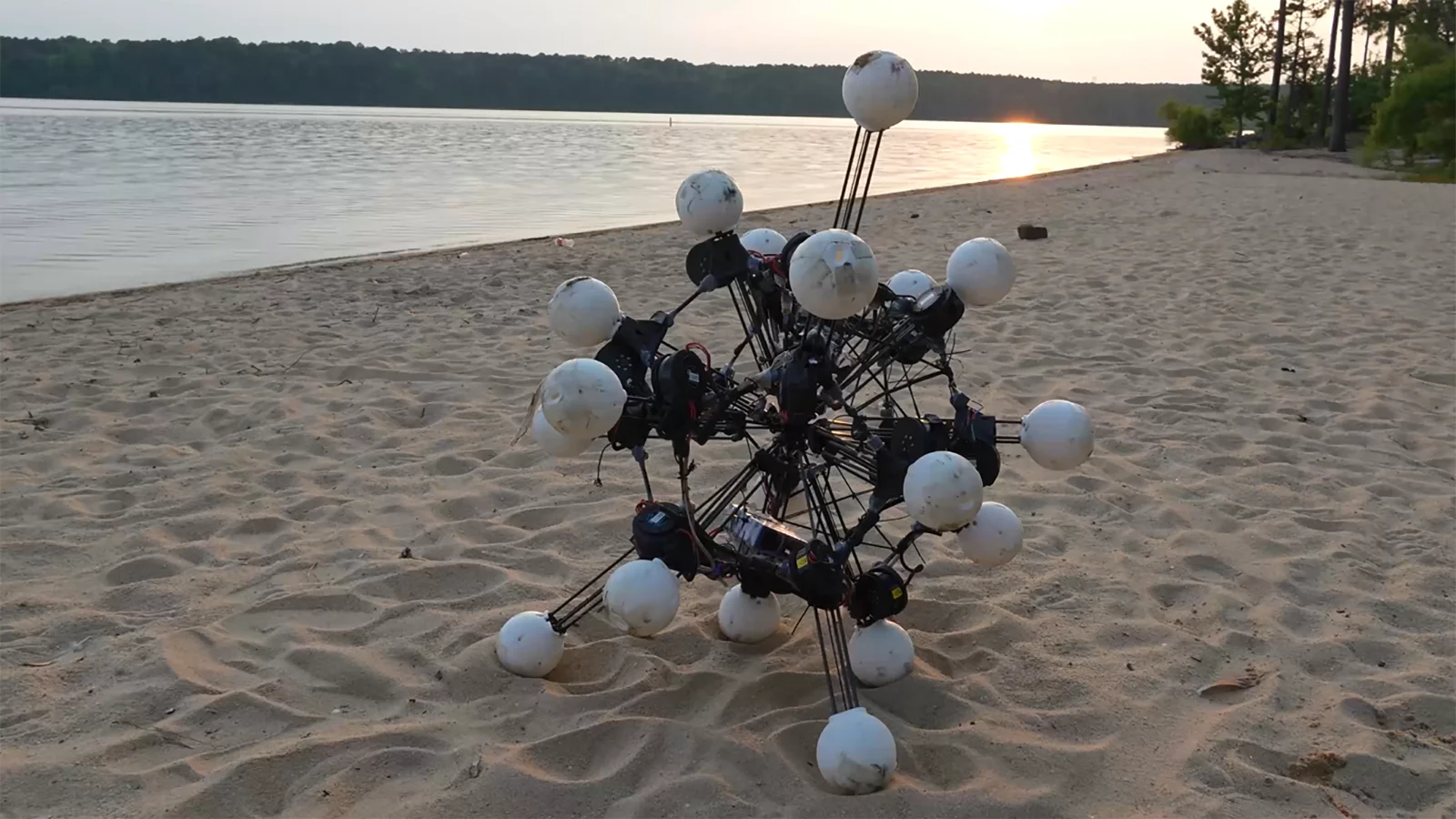
Photo Credit: Duke Engineering

The roboticists call the Argus design “dynamic isotropy.” The advantage is that Argus can accelerate in any direction much faster than quadrupeds, humanoids and conventional drones. The Duke researchers say Argus easily traverses forests, wet surfaces and sand, self-stabilizes quickly, reorients instantly in any direction, climbs vertically between close walls, and can carry or push payloads around in a given space.
“Most robotics research has framed symmetry as a question about the body but we argue that the most powerful symmetry is at the level of what a robot can do,” says Boyuan Chen, who leads the Argus team and directs Duke’s General Robotics Lab. “When a robot can accelerate in every direction, it stops needing to face the world in any particular way. Forward and backward become the same. Left and right become the same. The whole problem of robot control changes character.”
Argus, named after the all-seeing sentinel of Greek mythology, pairs whole-body actuation with whole-body perception. Each of the 20 legs is arranged at the vertices of a regular dodecahedron, a 3D shape with 12 pentagon faces. This arrangement is what produces a near-uniform instantaneous acceleration and field of view in every direction. Argus is capable of carrying a 10-pound payload at nearly full speed. Argus also continues to move when three of its legs are broken.
Duke roboticists think the underlying research will lead to new design concepts for robots. Basically, they’re out to prove robots can be more than a pretty face. Still, a robot that doesn’t scare children is a design element worth considering.
Techstrong TV
Digital CxO Podcast
Digital CxO Webinars