
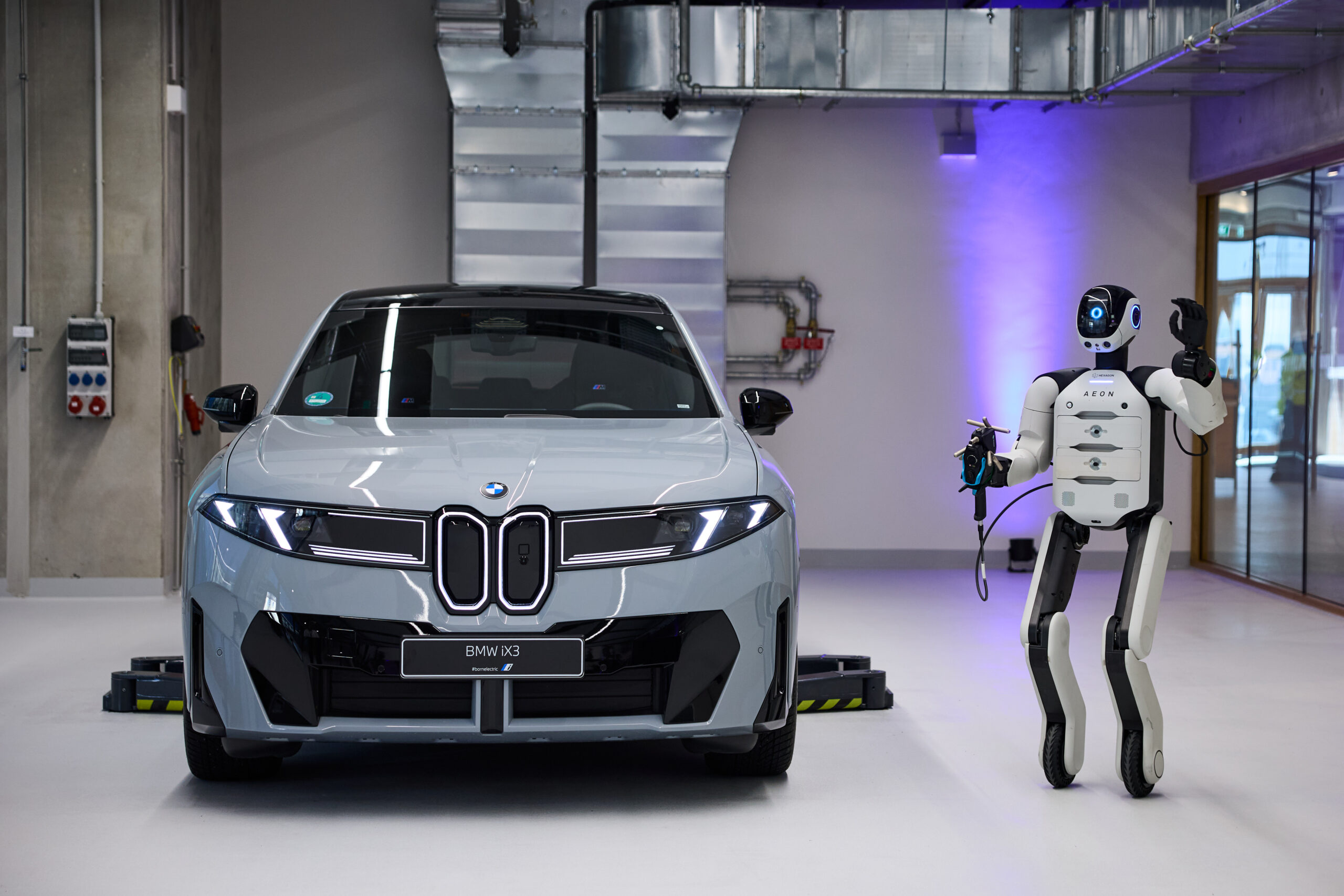
It should come as no surprise that when automotive giant BMW decided to put AI humanoid robots to work on the production line at its plant in Leipzig, Germany it would replace the feet with wheels. That simple move, however, may signal the dawn of widespread use of physical AI in industrial settings.
A new report from IDTechEx says automotive manufacturing will be the first major industry to adopt humanoids for widespread use. The main reason for early adoption of robots on the car assembly line is the strong backing of the car manufacturers themselves who see a clear return-on-investment regarding repetitive labor-intensive work. These jobs include basic but scalable tasks like material handling, inspection support, internal transport, and simple assembly assistance that can be done reliably time after time.
Making it feasible is a controlled operating environment that is suitable for robots. Putting BMW’s robots on wheels takes advantage of the smooth factory floors that improve the humanoids overall mobility (2.5 meters per second) while using energy efficiently. The IDTechEx report, Humanoid Robots 2026-2036, notes that in the past 12 months, activity has shifted from trade show demonstrations to structured pilot programs on production sites.
Credit: BMW
Foremost among automotive instituting such pilot production projects is BMW. The German company first experimented with a humanoid robot called Figure 2 at its Spartanburg, S.C plant over a 10-month period where the robots worked 10-hour shifts supporting the production of 30,000 X3 models. Figure 2 handled the precise removal and positioning of sheet metal parts for the welding process, a job considered to be physically exhausting.
“The successful first deployment of humanoid robots at our BMW Group plant in Spartanburg in the USA proves that a humanoid robot can function not only under controlled laboratory conditions but also in the existing automotive manufacturing environment,” said Michael Nikolaides, senior vice president production network, supply chain management at BMW. “The transition from laboratory to real production was, for me, faster than expected,” he added.
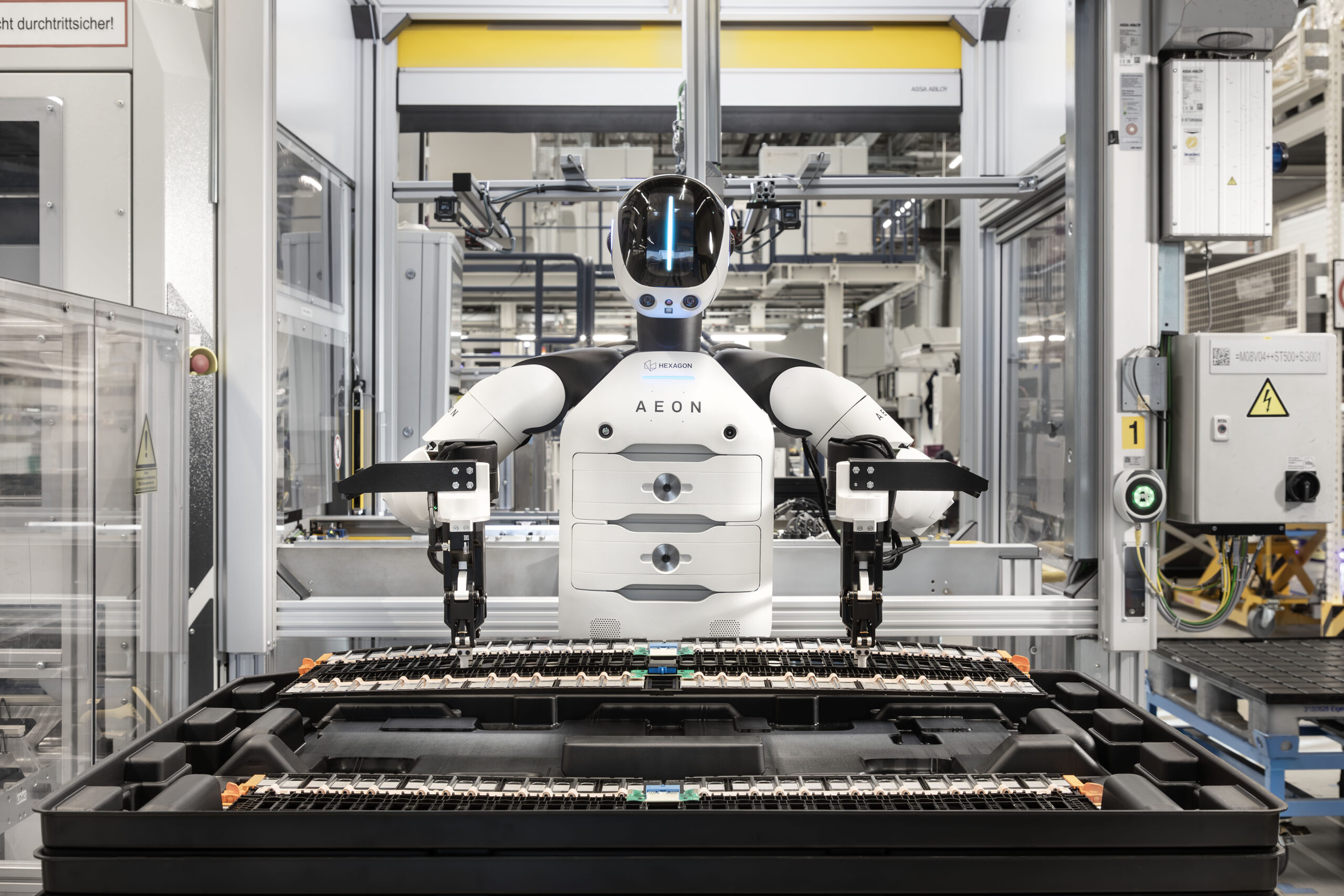
While an American supplier was used in the Spartanburg project, BMW is using a European one for its Leipzig program. Aeon is a humanoid robot developed by Zurich-based Hexagon Robotics equipped with 22 sensors and 34 degrees of freedom of motion. Aeon is being used specifically for component manufacturing and high-voltage battery assembly. Aeon also performs a neat trick with its own battery in that it can swap out an old one for a new one in 23 seconds so it can remain operational without needing lengthy charging interruptions. Aeon uses 360-degree cameras and microphones so it can react to obstacles or passing employees in real time.
Crucially, Aeon’s artificial intelligence springs from curated, domain-specific factory data and proprietary training material rather than the open internet to reduce the risk of hallucination. Two onboard NVIDIA Jetson cards—one for sensor fusion and the other for task execution—can correct errors in real time without cloud dependency.
Credit: BMW
Aeon learns across four layers of physical AI. These include simulation and reinforcement learning, perception-based task completion wherein a simple command is used for a complex task, imitation learning and digital twin world models that enable Aeon to handle unfamiliar objects, deduce their function and how to grip them. This fourth level is akin to an autonomous AI agent that can independently navigate through a plant environment and make its own decisions about production processes and requirements.
While Aeon may seem superhuman, regular people still have an edge. Robots are a long way from jumping into a moving car on a production line and assembling parts. But while the Aeon pilot program now has just two robots, the expectation is that thousands will be put to work on automotive production lines across the industry. South Korea’s Hyundai, for example, says it will use an Atlas humanoid developed by robotics leader Boston Dynamics in its plants by 2028. Tesla and Chinese carmaker BYD are expected to make similar moves. Xiaomi, another Chinese car company, reportedly has trialed a humanoid robot on a production line for simple tasks. The IDTechEx report expects the automotive industry to drive humanoid AI robot growth for the next five years. Globally, the AI humanoid sector is expected to reach $30 billion by 2036 with logistics and security also seen as leading growth sectors.
