
While the color scheme of the ball being used for the final stages of this year’s World Cup differs from that used in earlier tournament matches, soccer fans still may be eyeing FIFA’s high-tech “Connected Ball” with suspicion after it became the center of controversy.
Ironically, the rechargeable “Trionda” World Cup ball made by Adidas is meant to end controversial referee decisions. Inside the ball is a tiny inertial measurement unit (IMU) sensor made by Kinexon that operates at around 500 Hz and captures data 500 times per second, according to FIFA, soccer’s global governing body. FIFA says it can track ball acceleration and granular movements in three dimensions. This data is combined with that from in-stadium cameras. The technology is primarily designed to help with difficult offside decisions and other incidents involving unclear touches.
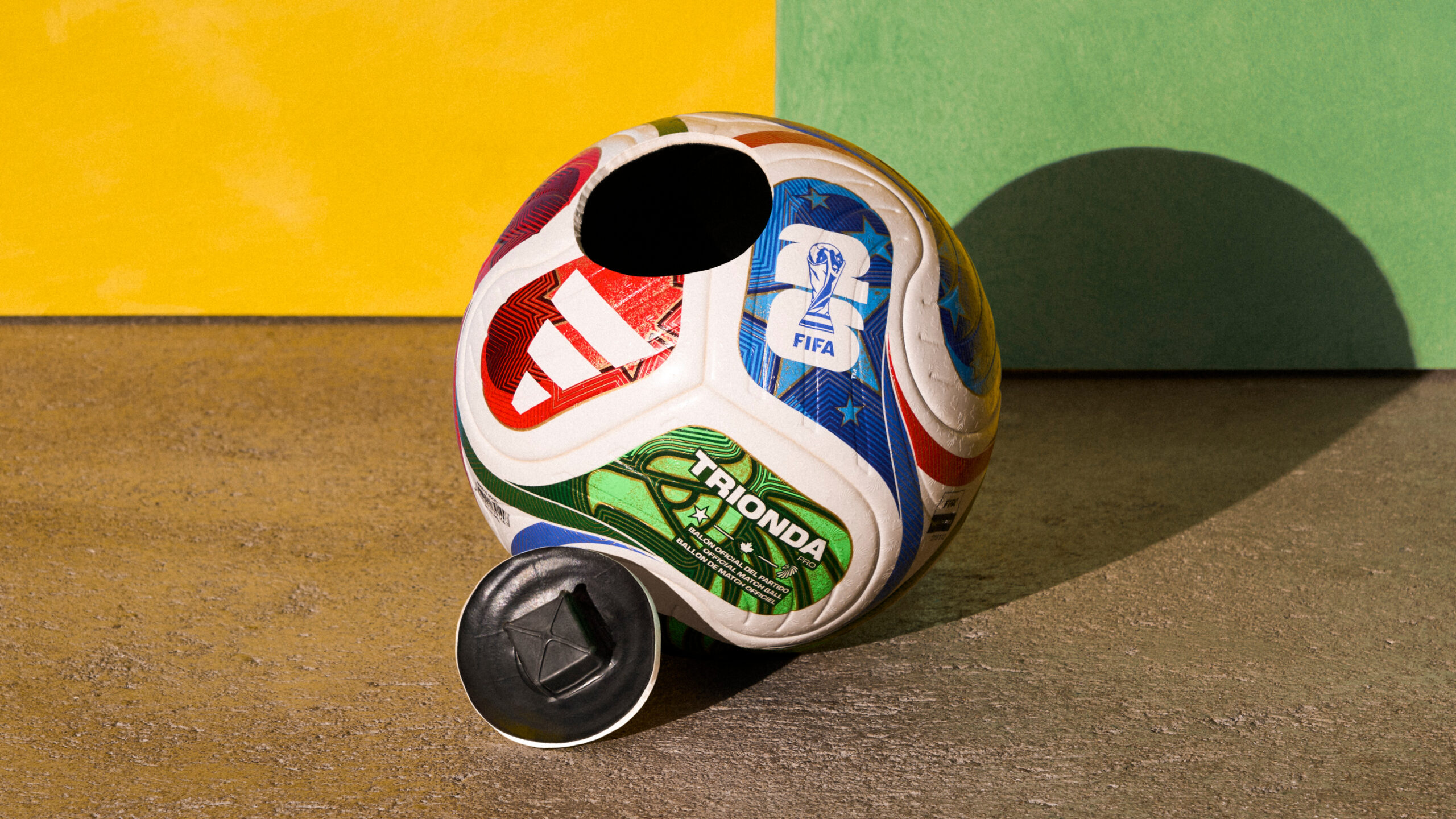
Photo credit: Adidas

Despite the deep-seamed ball’s high-tech credentials, it is now the object of suspicion. During the Norway vs England quarterfinal, a kicked ball appeared to hit the wire linked to the overhead Spidercam, significantly altering the ball’s trajectory and thereby changing England’s fortunes. England’s Jude Bellingham took advantage of the apparent deflection to score a critical goal. The sensor inside the ball should have detected the impact and play would have been halted due to the interference.
That didn’t happen. Instead, play continued uninterrupted. A VAR (video assistant referee) technical review was not invoked. Bellingham scored, tying the game at 1-1. England ultimately would advance after a 2-1 win. Postgame, FIFA said there was no evidence in the data recorded by the ball of any contact with the overhead camera wire.
“Before England’s goal in minute 45+2 against Norway, the sensor in the Connected Ball showed no peak in the ‘heartbeat of the ball’ when in the air, and therefore no evidence that the ball touched the overhead wire and changed the movement of the ball,” said FIFA in an X post.
Reaction was as swift as a free kick. “FIFA is telling you not to believe what you’ve seen because they’ve got something else instead,” said former English player Nedum Onuoha in a social media post that echoed many others. “This is an insane position to be in. Are we stupid now?”
Fans might be more accepting of FIFA’s ruling if it were not for a similar incident in a prior game between Portugal and Croatia. A stoppage-time goal by Croatia was disallowed after the ball brushed a Croatian player’s hair, leading to a nullifying offside ruling. In this instance, a technical VAR review proved to be the deciding factor. Real time and slow motion camera replays failed to detect any touch. Portugal advanced.
The discrepancies between the two matches show how important implementation and interpretation of ball data can be. That soon may become an important topic in other sports as automated officiating proliferates. The NBA announced it would experiment with “connected balls” in its summer league games, for example.
For many soccer fans, however, “no evidence” doesn’t mean it didn’t happen. A technology designed to eliminate controversy in the game has created new ones. The new Trionda ball for the final matches of the 2026 World Cup involving England, Argentina, France and Spain features a ball with a black, white and gold with red flourishes as the color palette. Regardless of any color change, soccer fans will be following the ball closer than ever.
Techstrong TV
Digital CxO Podcast
Digital CxO Webinars