
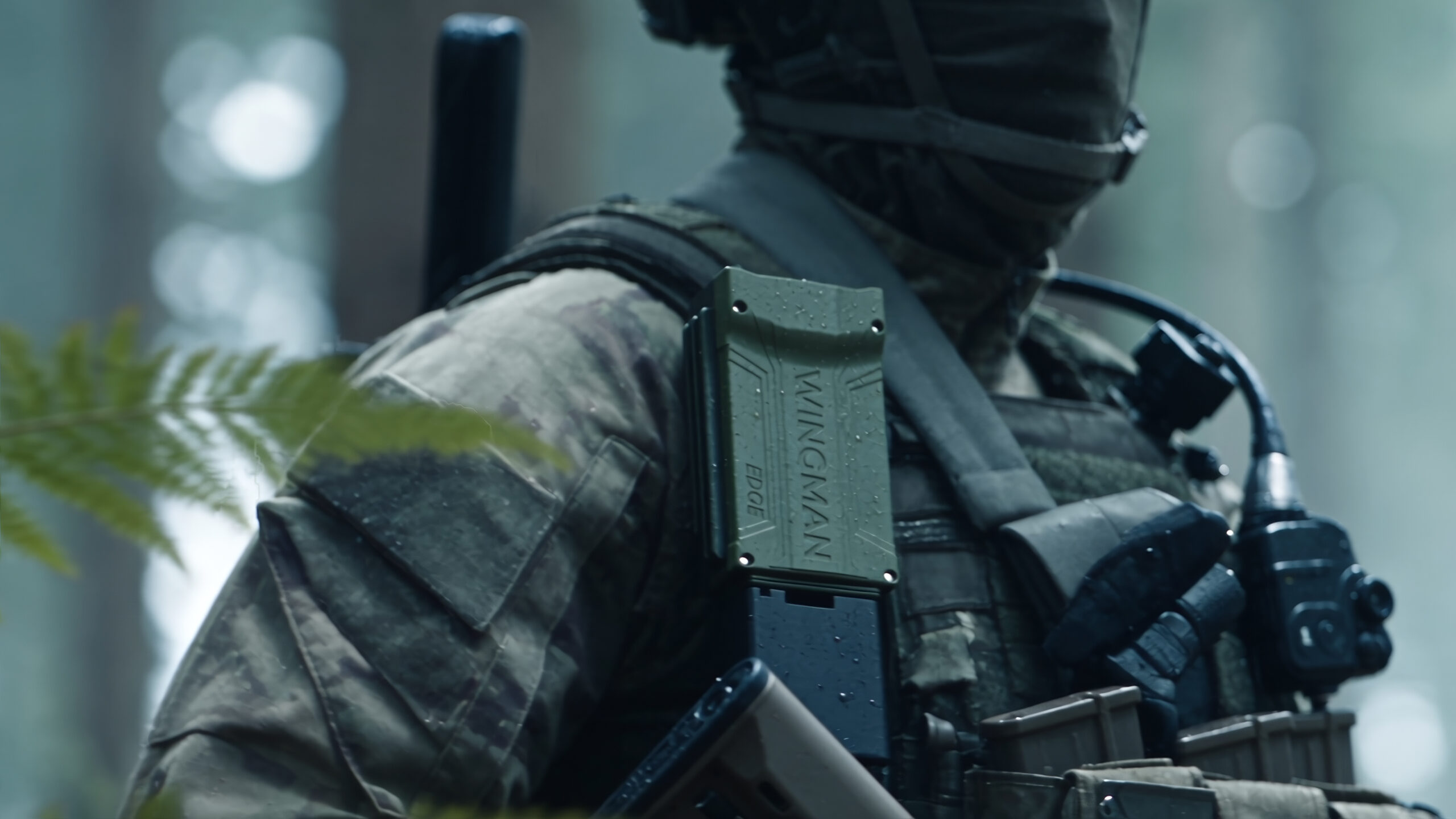
Personal protection against drones takes a practical step forward with the release this week of the Wingman Edge, a lightweight device that uses onboard AI-powered RF spectrum analysis to warn soldiers when hostile drones are nearby.
Developed by MyDefence of Denmark, the Wingman Edge weighs just 2.2 pounds, which is about 17 percent lighter than prior models made by the company. The Wingman Edge also is smarter. The onboard AI aspect means the device can analyze RF activity in real time beyond the signals already stored in its threat library.
“The evolving drone threat does not wait for a database to be updated,” said Dan D.S. Hermansen, CEO of MyDefence. “For more than a decade, we have put wearable drone detection into the hands of soldiers. Wingman Edge builds on that foundation by giving the individual soldier a much deeper understanding of what is happening in the spectrum around them, including activity that does not match an existing signature.”

Wingman Edge is passive by design so it can monitor the electromagnetic environment without transmitting RF energy that would reveal a soldier’s position. MyDefence says its “spectrum intelligence system” combines company software, threat knowledge and AI. Devices also can be linked to each other to share detections and paint a wider operational picture. MyDefence says Wingman Edge is the first of a family of AI products that will bring sensing, processing and intelligence closer to deployed troops.
MyDefence counts the U.S. Army among its customers as it has purchased $77 million worth of its wearable drone detectors over the past 18 months.
Wingman Edge is the latest tech development in a fast-moving field. Investment in counter-drone technologies has surged, growing sixfold during the last two years in the EU, for example. Despite that surge, only a third of the programs are expected to be completed by 2030, according to a confidential EU report seen by Euronews.
A potential market for wearable drone detectors is developing for civilians working in potentially hostile locations. Thus far, buyers in the private sector typically work for oil companies and other large corporations that can afford relatively stiff price tags. The popular Chuyka 3.0 detector, priced at $1,800, made by Blue Bird Tech of Ukraine, can detect signals 2.4 miles away. Kara Dag, a Ukrainian-American operation, offers a detector that hacks into the video feed of an oncoming drone. If you see yourself framed in the picture, it’s time to take cover.
Techstrong TV
Digital CxO Podcast
Digital CxO Webinars