
It’s all about speed now. The race is on to develop a new breed of fast interceptors to counter jet-powered drones that have been impossible to catch.
Jet-powered drones are wreaking havoc in Ukrainian skies. More than 2,500 jet-powered drones were launched by Russia against Ukraine in the month of August, according to the Ukrainian government, with the last four days of August seeing a concentration of 800 attacks. That number is up from the 1,500 launched in July. The jet-powered Shahed drones, known as Geran-4 and Geran-5, are three times faster than the original models acquired from Iran.
The wave of jet-powered drones has been accompanied by a change in tactics. There are more daylight attacks and targets include more obviously civilian infrastructure like food warehouses as well as energy infrastructure. A recent attack on a residential neighborhood caused 37 deaths. More “culture war” style targets include a warehouse attack that reportedly destroyed 12 million textbooks at the start of the school year.

The wave of constant attacks during daylight hours is meant to disrupt civilian life in order to crush morale, say analysts, while also exhausting Ukraine’s air defense system. Ukrainian officials suggest that Russia is trying to build a narrative of success ahead of its own upcoming parliamentary elections to counter the reality of stalled offensive ground operations.
The Russian jet drones with more robust airframes carry a higher price tag, estimated to be about $100,000 each compared to propeller-driven models costing between $25,000 and $50,000 each. Jet drones also burn fuel faster, which limits their range, an operational restriction that may partially explain why most jet drone attacks have been centered around the capital, Kyiv.
Ukraine has been using its limited number of combat aircraft against Russian jet-powered drones, but their effectiveness is clearly limited. The Ukraine conflict has been a chess game of innovation and Ukraine appears to be working on its next move. Ukraine reportedly is testing four new specialized interceptor systems. Performance specifics are scarce at this point but a major challenge will be scaling up production to thousands of interceptor units quickly. At the same time, Ukraine also is working on solutions to counter ballistic missile threats made dire by a shortage of Patriot missiles that would defend against them.
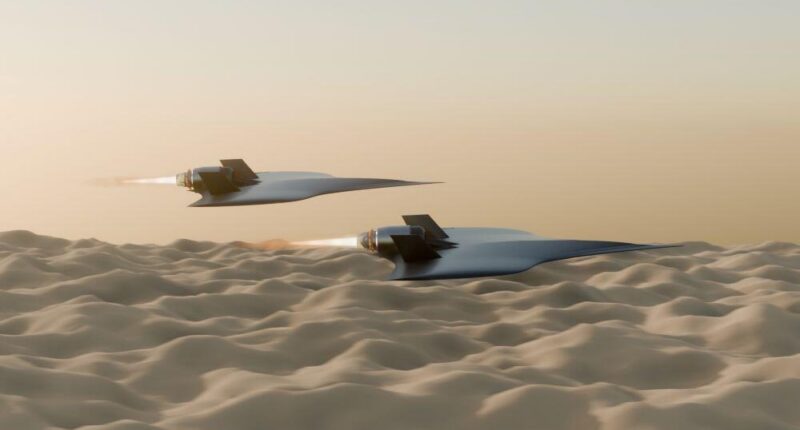
Source: Impact of Sable interceptors
Local media reports suggest a Ukrainian jet drone interceptor called Alexa Spatium has passed muster. Many details have been withheld but Alexa Spatium reportedly can be launched using a truck-mounted mobile catapult system and is able to return to base for reuse if the mission is aborted, the latter a feature that may be suggestive of a flight time more limited than standard drones. Alexa Spatium can be equipped with a variety of warhead types including high-explosive fragmentation, shaped-charge, and thermobaric and has an infrared targeting system in addition to a camera. Production numbers appear to be far below those needed at the present time.
Also in the Ukrainian developmental loop are jet drone interceptors but they may not be fast enough. They include an upgraded version of the proven Sting interceptor and the 310 mph P1-Sun Jetkiller from Skyfall spotted at the UK’s recent Farnborough Airshow. Shahed jet drones reportedly have a top speed of 450 mph, so any interceptor ideally needs to be a little faster in order to catch up.
What the 210 mph Zirka lacks in speed it hopes to make up for in precision. Developed principally by a company called Noctis, the Zirka reportedly uses AI to automatically lock on to a target and adjust its flight path dozens of times per second. Smarter may be slower, however.
A possible American solution to the jet drone problem is being hawked by a startup called Impact Drones. The company says it developed its Sable delta-wing drone interceptor in just two weeks. Sable is powered by a turbine engine capable of speeds up to 466 mph. The company says Sable will make its maiden flight soon.
On the flip side, the faster speed required of battery-driven jet drone interceptors may significantly reduce flight time. A possible alternative is some type of chemically driven propulsion system that may yield extra time, a project reportedly under development by General Cherry, a well-known Ukrainian manufacturer.
The challenge is formidable. As one Ukrainian official noted, offensive capabilities always stay one step ahead of defensive ones. Survival depends on how quickly one adapts to the new threat. Speed is of the essence.
Techstrong TV
Digital CxO Podcast
Digital CxO Webinars