Technology leaders are being asked to introduce a new class of software that can act, not merely answer, while keeping every existing service available, secure and compliant. The winners will not be the companies that deploy the most agents. They will be the ones that turn more experiments into durable production.
Every technology leader knows the metaphor: rebuilding the engine while the plane is still flying. Agentic AI makes it literal. Enterprises are introducing systems that can choose tools, retrieve data, invoke applications and take actions, even as the rest of the technology estate must continue operating without interruption.
There is no maintenance window for this transition.

The temptation is to treat agentic AI as another adoption race. Buy the tools. Launch the pilots. Count the users. Put an agent into production and declare progress. But deployment is the easy milestone. The harder question is whether the surrounding system is finished: Are permissions bounded? Can operators reconstruct what happened? Can the organization recover cleanly? Does someone own the outcome? Does the economics still work after human review, exceptions and rework are included?
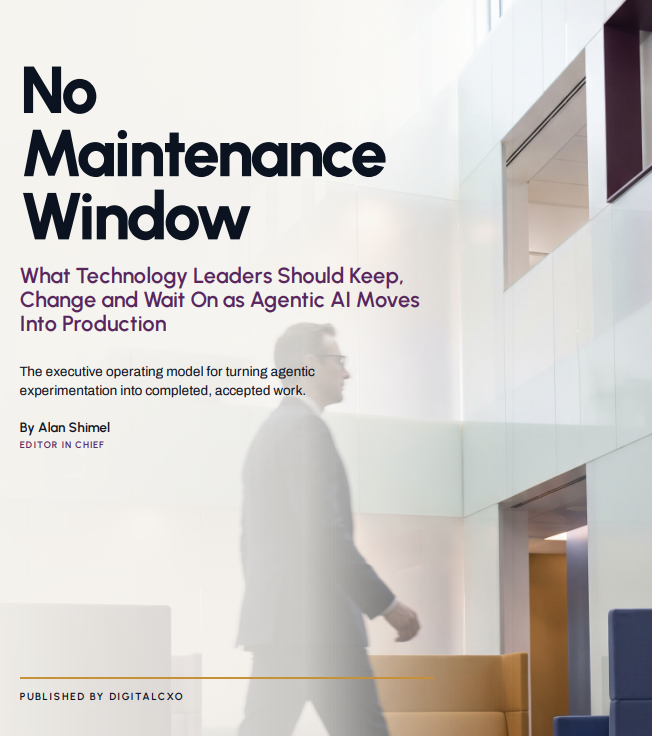
That gap between deployment and durable production is the central subject of our new Digital CxO special report, No Maintenance Window: What Technology Leaders Should Keep, Change and Wait On as Agentic AI Moves Into Production.
Adoption Is Moving Faster Than the Operating Model
The data suggests that enterprises are advancing, but not in a straight line. Futurum’s 1H 2026 AI Platforms research found 52.6% of respondents still researching or piloting agentic AI. Another 19.1% were deploying a single agent in production with human oversight, while only 6.3% described an autonomous ecosystem governed mainly by exception.
That does not mean AI is failing. It means production readiness is more demanding than technical capability.
McKinsey’s 2026 global survey found that 44% of respondents said AI was scaling across their enterprise and 80% reported personal productivity gains. Yet only 37% attributed any EBIT impact to AI, and just 6% met McKinsey’s definition of an AI high performer. People can produce more while the enterprise struggles to convert that activity into accepted, measurable business outcomes.
The control gap is just as important. IBM found that two-thirds of the CIOs and CTOs it surveyed were accountable for AI systems they did not fully control. Seventy percent said business teams were deploying technology faster than IT could track, and only 11% felt fully prepared for the expected scale of agent deployment.
This is not simply a model problem, a data problem or a governance problem. It is all of them at once, connected through a production workflow.
Production Cannot Be the Finish Line
The word “production” has become too easy to claim. A live model endpoint is in production. So is an assistant made available to employees. Neither tells a CIO whether the capability is dependable, recoverable, affordable or ready to scale.
The report proposes a more useful fourth stage: durable production. A durable workflow can be repeated, observed, secured, recovered, economically justified, adapted and eventually retired. It has defined acceptance thresholds and a named human owner. That is the point at which AI becomes an enterprise capability rather than a recurring demonstration.
Reaching it requires leaders to distinguish among what should remain, what must change and where patience preserves options.
Keep the disciplines that already make production dependable: reliability engineering, least privilege, data lineage, modular architecture, change management, incident response and human accountability. Agentic AI does not make those practices obsolete. It raises the cost of neglecting them.
Change how those disciplines are implemented. Governance has to move from policy documents into runtime execution. Agents need distinct identities and narrowly scoped authority. Funding must cover evaluation, monitoring, security, model changes and retirement, not just the proof of concept. Measurement must move beyond prompts, tokens and hours saved to the fully loaded cost of completed, accepted work.
Wait before granting broad autonomy where the organization cannot observe, constrain or recover from the consequences. Waiting is not the same as standing still. Teams can test bounded workflows, read-only access, staged changes and human approval gates while a use case earns greater authority through evidence.
The Leadership Test Is Whether the Organization Can Finish
Agentic AI lives in the seams between executive roles. An agent may run on a platform managed by the CTO, use data governed by the CDO, act through credentials overseen by the CISO, alter a service owned by the CIO and sit within a portfolio directed by the CAIO. Shared leadership is unavoidable. Diffuse accountability is not.
That is why the full report moves from diagnosis to an operating framework. It defines eight gates for durable production, covering measurable outcomes, bounded workflows, production-grade context, identity and authority, evaluation, observability and recovery, completed-work economics, and ownership and retirement. It also lays out a 90-day agenda for inventorying the AI estate, building a paved road of shared controls and forcing explicit decisions to scale, contain, hold or stop each workflow.
The enterprise objective is not maximum autonomy. It is durable production.
The strongest organizations will not eliminate experimentation; they will become better at ending it. They will know what has earned the right to scale, what needs to remain bounded and what should be stopped so that people and capital can move to work the organization can actually finish.
Techstrong TV
Digital CxO Podcast
Digital CxO Webinars