
Ukraine’s AI-driven Delta battlefield software management ecosystem appears to have evolved into what may be an unrivaled military asset. At least 70 AI-enabled platforms now operate under the Delta umbrella. Among the latest additions is an AI chatbot called SPECTR that links into Delta to allow commanders to directly ask questions about the best way to plan an attack, for example.
Another new addition is an Overwatch Positioning Network, developed by Sparc AI, that provides navigation information to drones when satellite data is disrupted by electronic jamming. Overwatch is able to process a drone’s existing sensor data and confirm the drone’s position in one-third of a second. The Overwatch system sends drone telemetry via an application programming interface that allows Overwatch to use terrain models and sensor-fusion algorithms to calculate coordinates.
Delta can best be thought of as a central nervous system sensitive to data that includes satellite imagery, drone video, radio intercepts and even eyewitness observations. Data available to operators includes when a target was first spotted, how many times it was attacked and by which units. A key aspect enabled by AI is response time: the “kill chain” has been whittled down from 20 minutes in the past to three to five minutes today. Delta reportedly began as an effort by a volunteer group called Aerorozvidka that began experimenting with drones in 2014 as a way to report enemy targets more quickly.

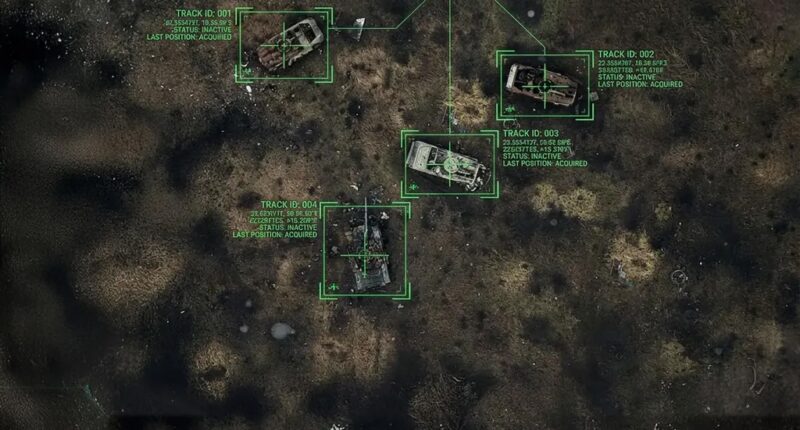
Photo: Ukraine Ministry of Defense.
Elements of Delta are being adopted by other countries. Ukraine and the United Kingdom just inked a deal that gives the UK access to Ukraine’s Avengers AI Labs, a platform built on real-world battlefield data from thousands of sensors. The UK will use this data to train military AI models, signaling a closer relationship between the two countries. The UK is the first international partner to access Avenger AI data. One project already underway combines Ukrainian data with UK tech to turn buried fiber optic cables into AI-enabled sensors. It’s unclear whether the UK/Ukrainian deal will serve as an unofficial backdoor for other NATO members.
“By giving British start-ups, researchers, engineers, and technology companies access to insights from its Avenger AI platform, we are taking that partnership further and helping Britain develop the next generation of defense technology,” said Kanishka Narayan, UK minister for artificial intelligence.
While Ukraine has been using AI tech for years in its war with Russia, Western militaries took particular notice during a NATO war game in Estonia in May 2025. Ten Delta-equipped Ukrainian drone operators pulled from the front line with Russia quickly simulated the destruction of 17 armored vehicles and two brigades of troops while also hitting numerous other targets. One NATO commander reportedly summarized the exercise in three words: “We are fucked.” The Ukrainians doubtless thought they were on vacation.
A similar experience befell Swedish troops in an exercise in August in which Ukrainian drone pilots simulated the role of an aggressor. The Gotland exercise reportedly was restarted three times as Swedish troops were “killed” quickly.
Ukraine, of course, has a massive head start at being able to view the battlefield through “a single pane of glass,” essentially using AI to reduce battlefield management to an app. By contrast, U.S. Army Secretary Daniel Driscoll told the Senate Armed Services Committee in May that Ukraine puts every drone and shooting platform on one network and that American systems do not. AI military systems like those developed by Palantir are mostly used at command centers with a strong internet connection. Delta can work offline.
The Pentagon is spending millions of dollars trying to catch up, likely hindered by the Trump administration’s aversion to anything Ukraine. For example, the Pentagon just awarded Austin-based NODA AI $100 million to develop an “orchestration” software layer that can operate across different vendor systems so commanders have greater flexibility in selecting assets for a mission. The challenge yet to be met is turning orchestration software layers into a single effective warfighting system. Like Delta.
Techstrong TV
Digital CxO Podcast
Digital CxO Webinars