
A backyard drone drop zone soon may be a desirable attribute of modern homes as Amazon moves to expand drone delivery service to nearly 500 cities by the end of the year. The planned expansion of Prime Air will increase delivery locations six-fold over its current footprint.
The Prime Air expansion is buoyed by its current success in making deliveries in about an hour across cities in seven states. “We’ve already delivered hundreds of thousands of packages to customers by drone this year,” said David Carbon, vice president of Amazon Prime Air, in a blog post.
Up first will be new drone delivery flights for Chicago, Syracuse, Cleveland, Atlanta and Boise. Additional cities will be announced in time. Current drone deliveries are available in Phoenix, Omaha, Kansas City, Detroit, Baton Rouge, Tampa, as well as San Antonio, Dallas, Houston and Waco in the state of Texas.

Drone delivery is a perk for Prime members on orders over $50. A $2.99 charge is added for deliveries under $50 while non-members are charged $4.99. Customers can choose the delivery site.
Drone packages typically weigh five pounds or less. Amazon says it is trialing a “gentle delivery option” for fragile items like eggs. A retractable tether lowers items to the ground in a shift from a bombs-away drop from 13 feet. Competing drone delivery services Wing and Zipline already use tethered delivery. Wing is well-entrenched as the drone delivery option for Walmart. Zipline this week said it will partner with Uber Eats, aiming for one million deliveries per day by 2029.
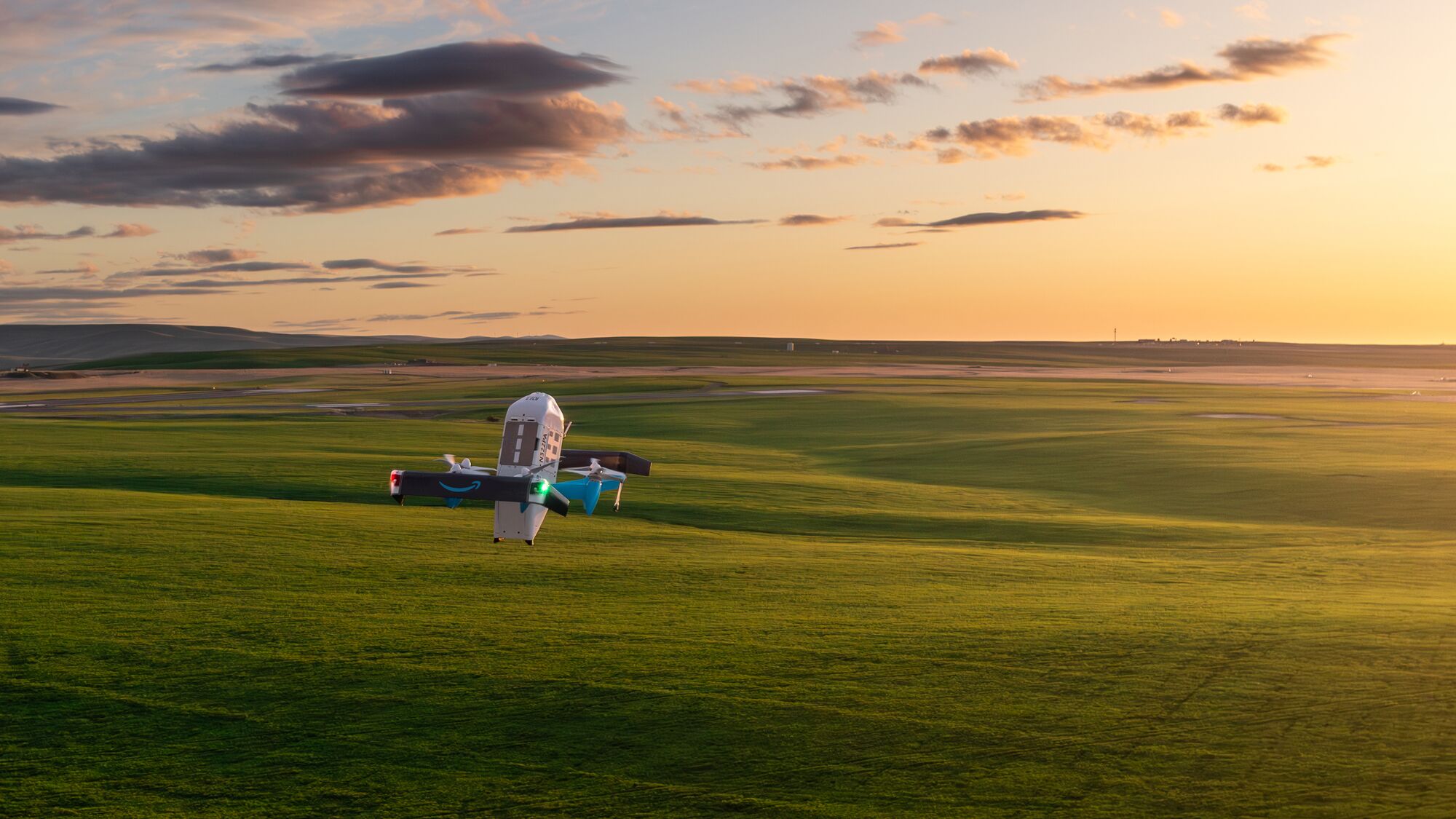
Photo credit: Amazon
“Our goal is for millions of people to be able to order lunch, dinner, snacks and more through the Uber Eats app and have them delivered by Zipline in five to 10 minutes,” said the company. Zipline said its drones cruise at about 70 mph within a 10-mile service area.
The skies are likely to become more crowded as DoorDash Air becomes the latest ready for takeoff. To date, eight drone delivery operations have received Federal Aviation Administration (FAA) Part 135 air carrier certification. Uber also works with a drone delivery service called Flytrex.
It may not all be smooth flying. The proliferation of low-flying drones on “drone highways” is prompting noise complaints from homeowners along the flight path. Homeowners compare the noise to that of beehive attack. Other concerns include the risk of crashes, especially in confined spaces, and privacy. Prime Air says the on-board cameras are used strictly for navigation and obstacle detection and do not track individuals or record movements.
Law enforcement also is increasingly concerned about drone deliveries of contraband. Police in France recently arrested a ring making drone deliveries of items like cash, drugs, and cigarettes to a prison in Villefranche-sur-Saone. Digital evidence revealed that 1,800 drone flights had been made to the prison over a two-month period. Similar incidents in Canada and elsewhere have put drone detection technology on prisons’ most wanted list.
Techstrong TV
Digital CxO Podcast
Digital CxO Webinars