
While humanoid robots are drawing a lot of attention, the shape of physical AI is increasingly being influenced by the animal kingdom. Perennial favorites like robot dogs are being joined by robots that can fly and dive under water and snakes that writher across overhead wires.
Diving birds that can swim before taking flight once more are the inspiration for a flapping-wing aerial-aquatic vehicle (FAAV) developed by engineers at MIT and EFPL of Switzerland. The FAAV has a central body or fuselage, two flexible wings and a steerable tail in a package that weighs less than 300 grams. While the FAAV helps scientists understand how diving birds like puffins adjust their flight mechanics to move through air and water, the long-term goal is to develop a class of winged robots.
“Our dream is for oceanographers, marine biologists, and members of coastal communities to launch this robot from a boat or from shore and it would fly close to the area of interest such as an iceberg or a port facility or over a pod of whales,” says Raphael Zufferey, assistant professor of mechanical engineering and head of MIT’s AURA LAB. “It would dive into the water to take a measurement or collect a sample and fly back to deliver the data at a fraction of the cost of traditional methods. Then it could go back out to dive for more.”

Taking a cue from nature, Zufferey and his colleagues applied the same variable flapping wings speeds used for water and air travel. The wings are made of thin membranes coated with hydrophobic nanoparticles that wick away water. Power comes from a battery-powered, waterproof electric motor that drives a crankshaft. A motorized tail enables the FAAV to change direction and move up or down. One big difference is that the FAAV doesn’t paddle like birds during water takeoffs.
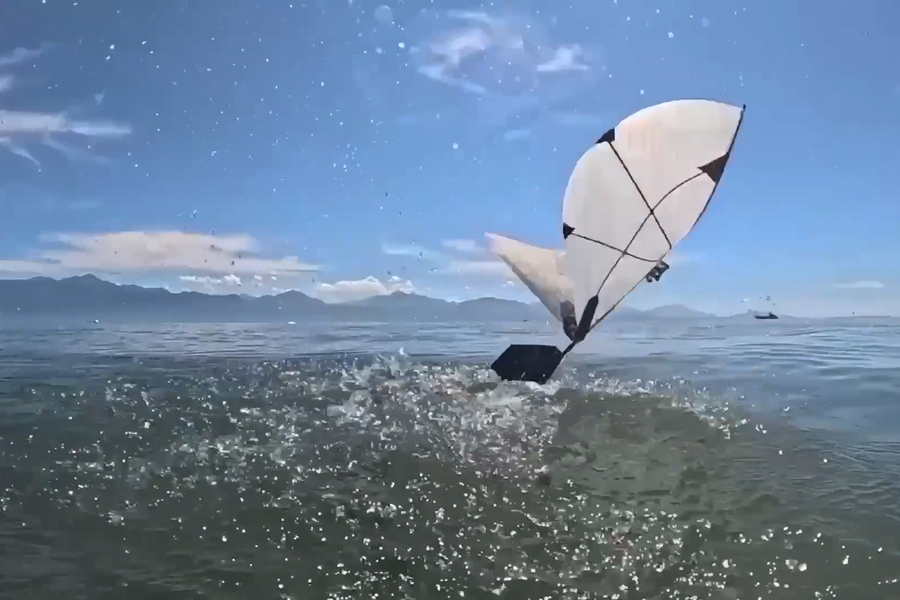
Photo credit: MIT/Raphael Zufferey
Also operating aloft are robotic snakes that wrap themselves around power lines for a visual inspection. Already reportedly deployed in China, the robot snakes, equipped with cameras and sensors, are being used to detect damaged wires and worn components. The robot snakes are said to be three times more efficient in detecting power distribution problems.
Man’s best friend may still be the robotic animal configuration to beat. Spot, the robotic dog made by Boston Dynamics, is a perennial favorite. Spot’s newest role may be as a delivery worker that rides along in trucks and then hops out to deliver packages to customers’ doorsteps. Boston Dynamics calls the last 50-foot “porch gap” the final frontier of logistics automation. Spot already has a secure place in fields like security and site inspections, for example.
Robotic dogs also appear ready to make some decisions on their own. South Korea’s KAIST institute has developed a robotic dog that can adjust its speed and gait according to the surrounding environment. The KAIST “Hound” can switch among forms of movement like walking, running, jumping and clearing ledges as circumstances require. The KAIST Hound was able to navigate difficult terrain while also traveling at a speed of almost 14 mph. The training data was derived from computer simulations, rather than motion capture data, and further refined using AI-enhanced reinforcement learning. The final version of Hound employs a depth camera and LIDAR, which help the robot recognize terrain and choose an appropriate gait. KAIST notes that its Hound can move across difficult terrain faster than wheeled models, a factor when it comes to emergency situations.
The day may soon come when robot dogs join hunts. In Japan, an animatronic scarecrow called Monster Wolf is backordered by golf course operators and farmers worried about bear attacks in particular. Monster Wolf is made from a pipe frame covered with artificial fur and features a rotating head, red flashing LED eyes, sensors, solar panels and speakers to broadcast a range of sounds from sirens to gunshots. The next step is to add movement, says its maker, Ohta Seiki. That sounds like a robot with legs and teeth.
Techstrong TV
Digital CxO Podcast
Digital CxO Webinars