
For nearly two years, one of the technology industry’s favorite predictions has been that generative AI would kill Google Search.
The argument seemed compelling. Why sift through pages of links when a conversational AI could synthesize an answer in seconds? Every improvement in ChatGPT, Claude or Perplexity appeared to reinforce the idea that the traditional search engine was becoming an artifact of the previous internet era. Google’s dominance, many believed, was finally facing an existential threat.
Then the numbers started coming in.

A recent analysis by Sherwood paints a very different picture. Google Search revenue continues to grow at an impressive pace. Traffic remains remarkably resilient. AI-powered features such as AI Overviews and AI Mode are reaching billions of users, not as separate products but as extensions of the search experience itself.
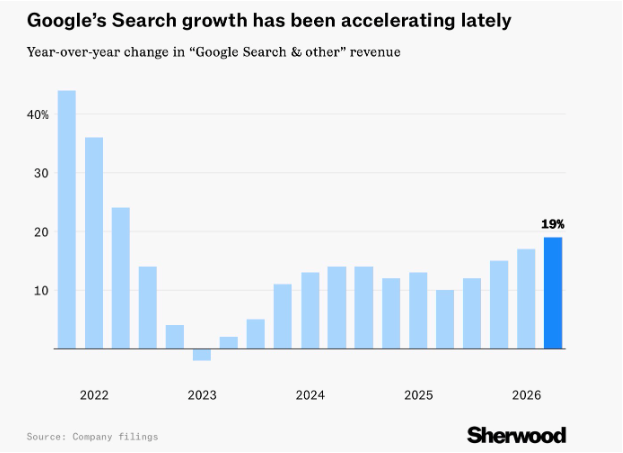
The data suggests that Google Search has not been diminished by AI. If anything, it has become stronger.
Many observers will interpret that as evidence that Google defeated ChatGPT.
I think that misses the bigger story.
Google did not win by preventing the AI transition. It won by embracing it quickly enough to redefine what search means before someone else could do it for them. In doing so, the company may have preserved one of the most profitable businesses in technology while simultaneously disrupting the economic model that helped create the modern web.
That second story deserves far more attention.
For much of the past 25 years, the internet operated on an implicit bargain. Publishers invested in journalism, research, reviews, analysis and expertise. Search engines organized that information and directed readers back to the original source. Publishers monetized those visits through advertising, subscriptions, events or lead generation, creating the revenue necessary to produce the next generation of content.
The arrangement was never perfect, but it worked well enough to fuel an extraordinary expansion of freely available information. Search engines benefited because publishers kept creating valuable content. Publishers benefited because search created discoverability. Users benefited because knowledge became easier to access than at any point in human history.
Generative AI changes the economics of that relationship.
When Google’s AI Overview answers a user’s question directly on the results page, the user often has little reason to click through to the source material. The answer satisfies the intent. Google retains the engagement. The publisher loses the visit.
Those outcomes are not contradictory. In fact, they may reinforce one another.
Search traffic can continue growing while referral traffic declines. Google’s search business can become more valuable at precisely the moment publishers find it increasingly difficult to monetize the content that makes those answers possible.
That possibility represents a far more consequential shift than another monthly leaderboard comparing chatbot market share.
The early conversation around AI search focused almost entirely on technology. Which model was smarter? Which interface was more intuitive? Which company would own the future of information retrieval?
The market appears to be answering a different question.
The companies that thrive may not necessarily be those with the best models. They may be the ones that already own the moments when users express intent.
Google understood that search is not merely a product. It is a habit.
Billions of people have spent decades conditioning themselves to open a browser and type a question into a Google search box. Rather than attempting to defend the familiar list of blue links, Google transformed the experience behind that behavior. Users did not need to adopt a new workflow or learn a new application. They simply continued doing what they had always done while Google’s AI quietly reshaped the interaction.
OpenAI deserves enormous credit for changing expectations around artificial intelligence. ChatGPT forced every major technology company to accelerate investments that might otherwise have taken years to mature.
Ironically, however, OpenAI’s greatest contribution may have been forcing Google to reinvent Search before competitors reinvented it for Google.
From a strategic perspective, that is an impressive achievement.
The broader implications become even more interesting when viewed through the lens of technology history.
The industry has a long record of confusing superior innovation with superior market position. Better technology does not automatically produce better business outcomes. Distribution, ecosystems and user habits have repeatedly proven to be decisive competitive advantages.
Microsoft’s dominance was built as much on ubiquity as technical superiority. Android leveraged distribution to become the world’s leading mobile operating system. Chrome achieved extraordinary adoption because it became deeply integrated into an ecosystem that users were already inhabiting.
Google enters the AI era with perhaps the most powerful distribution network ever assembled. Search, Chrome, Android, Gmail, Maps, Workspace and YouTube together represent billions of daily interactions. Embedding AI across those properties may ultimately prove more valuable than convincing users to adopt yet another standalone assistant.
At the same time, it would be a mistake to conclude that search itself remains unchanged.
In reality, search is becoming increasingly contextual.
Many people now instinctively turn to ChatGPT to understand unfamiliar concepts, Perplexity for cited research, GitHub for technical code, Amazon for products, YouTube for tutorials and LinkedIn for professional discovery. The notion of a single universal search engine is gradually giving way to a collection of specialized destinations optimized for particular forms of intent.
Seen through that lens, Google’s continued growth becomes even more remarkable. The company is not expanding in a stagnant market. It is expanding while the very definition of search becomes more fragmented and competitive.
Yet as impressive as Google’s strategic execution may be, the consequences extend well beyond Mountain View.
As someone who has spent decades building digital media businesses, I believe the publishing industry is only beginning to grapple with the implications of this transition.
For years, publishers optimized for search. Editorial strategies, content architectures and business models evolved around the assumption that quality content would eventually be rewarded with discoverability. Traffic became the currency that supported advertising, generated subscriptions and justified editorial investment.
If AI increasingly satisfies user intent without transferring that traffic, the assumptions underlying those strategies begin to erode.
The challenge is not simply technological.
It is economic.
Content does not appear spontaneously because an AI model requests it. Investigative journalism, industry analysis, product reviews and expert commentary require human expertise, time and financial investment. The internet has historically funded that investment through a system in which discovery generated audiences and audiences generated revenue.
AI compresses that value chain.
The platform increasingly owns both the user’s attention and the answer itself, while the creator of the underlying knowledge receives progressively less economic benefit.
Publishers cannot solve that problem by hoping users return to clicking links out of habit.
They will have to build businesses that create value beyond search traffic.
Some already have. Subscription businesses continue to mature. Membership communities create direct relationships between experts and audiences. Conferences, premium research, executive briefings and proprietary data products generate value that cannot be reduced to a short AI summary. Trust itself becomes an increasingly valuable asset when information is abundant but credibility is scarce.
In many respects, the publishing industry may be moving away from an advertising-driven model toward one built on expertise and relationships.
That transition will undoubtedly create winners and losers.
Organizations dependent on commodity traffic may struggle. Those with differentiated analysis, loyal communities and direct audience relationships may emerge stronger than before.
The open web has reinvented itself repeatedly over the past three decades. It survived the transition from portals to search, from desktop to mobile and from search to social distribution. Each transformation forced publishers to rethink how they reached audiences and how they generated revenue.
Artificial intelligence represents another transformation, but this one feels more fundamental because it challenges the assumption that creating knowledge naturally leads to owning the audience for that knowledge.
Google deserves considerable credit for recognizing this moment and responding decisively. Rather than defending the traditional search experience, the company rebuilt it before competitors could do so on its behalf. From a strategic standpoint, it may prove to be one of the smartest pivots in the company’s history.
For publishers, however, Google’s success forces an uncomfortable reckoning.
The conversation over the past two years has centered on whether AI would replace search. The more consequential question is whether AI is replacing the business model that funded the open web in the first place.
If that proves to be true, Google’s greatest AI achievement will not have been defeating ChatGPT. It will have been preserving and growing Search while demonstrating that the platform owning the answer captures an ever-larger share of the value.
The rest of the industry will have little choice but to adapt.
The next generation of successful publishers will almost certainly be built less around clicks and page views and more around trusted brands, proprietary expertise, premium communities and direct relationships with their audiences.
In the end, AI may not have killed search at all.
It may simply have ended the business model that made the open web possible and begun the search for the one that comes next.
Techstrong TV
Digital CxO Podcast
Digital CxO Webinars