
“Hey mister! How much for that dog in the window?”
“The real dog or the robot one?”
“The robot one next to the humanoid.”

That bit of dialogue might have been written for a sci-fi story just a short time ago, but it’s now likely to be a realistic conversation as robots go on sale. Actually, the conversation might be skipped altogether by buying online. Nonetheless, a new study from Stanford University suggests consumers might be wise to curb their enthusiasm.
Humanoids are quickly moving from the silver screen into everyday reality. A video of a humanoid named Edward Warchocki went viral after it chased off a herd of wild boars in Warsaw, Poland, turning Edward into an instant celebrity. In Beijing, the second Humanoid Half-Marathon takes place April 19, with Unitree Robotics’s H1 model already notching a running speed of 22.4 mph. In Shanghai, McDonald’s is experimenting with AI-powered humanoids greeting customers and assisting with food orders.
Unitree is one of two Chinese companies now offering AI-driven humanoid robots for sale. Unitree’s R1 model is available via AliExpress for $8,122.86. Unitree expects to ship 20,000 units in 2026.
Unitree’s pricing is significantly below that of the Aimoga Mornine M1, which is priced at $41,830. Aimoga is a brand of Chery, one of China’s largest automobile marques. Aimoga is developing an offline sales network that will include automotive dealerships as well as specialty stores and shopping experience locations in malls. Mornine M1, which looks like a sci-fi version of a blonde Viking Valkyrie, is offered alongside a robot dog named Argos priced at roughly $2,300. To lower the purchasing barrier for consumers, Aimoga offers long-term leasing and installment plans.
According to media reports, Mornine M1 stands at 5.4 feet and weighs 154 pounds. Mornine M1 has 40 degrees of freedom which allows it to effectively mimic human movement. Other specifications appear to be below mythical Valkyrie standards, however. Mornine M1’s walking speed is 2.2 mph and each arm can lift 3.3 pounds. Mornine M1 has one 3D lidar sensor as well as two depth perception cameras, a wide-angle camera and four ultrasonic radars. Battery life is two hours. Despite its formidable appearance, Aimoga is positioning Mornine M1 for roles in sales, hotel reception and education. Mornine M1 also is likely to find a role among gamers.

By contrast, Unitree’s R1 is four feet tall, weighs between 55 and 64 pounds (as there are two upgrade versions available) and looks like a character from the Japanese Power Rangers TV series. The R1’s size is deliberate as it targets home and school environments where its smaller size makes it less intimidating. Battery life is one hour and it relies mostly on a camera for navigation. Maximum arm strength is five pounds. The R1 has a wide range of movement, but the base model also lacks articulated fingers so it’s pretty much relegated to the role of “intelligent companion.” An upgrade to an EDU Pro version adds articulated fingers.
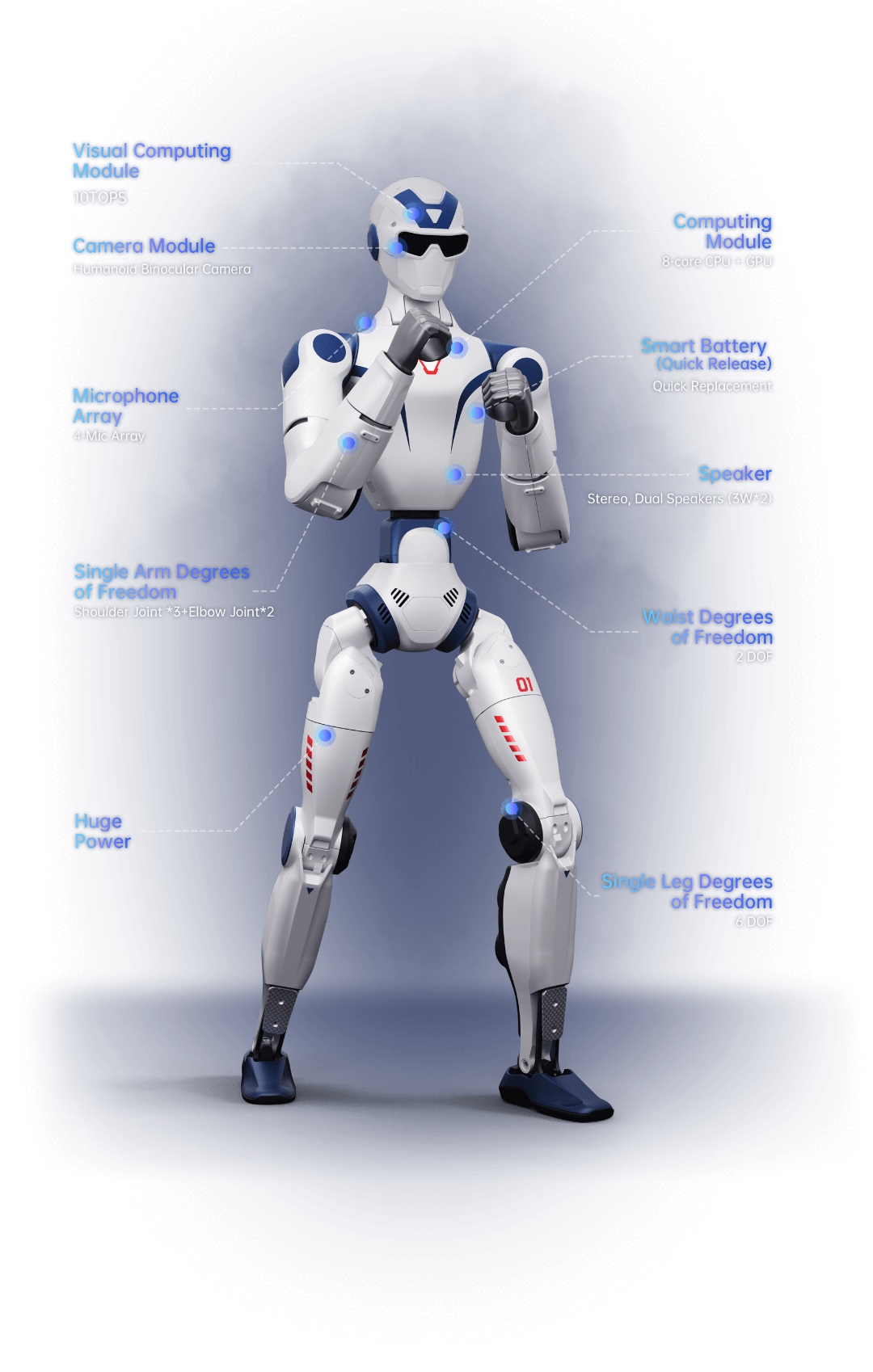
The Unitree R1 humanoid robot (Image: Unitree Robotics)
The chat versus chores dilemma is illustrated in a new study from Stanford University’s Institute for Human-Centered Artificial Intelligence. The 2026 AI Index Report notes that while robots achieve an impressive 89.4% success rate in controlled software simulations, humanoids may not be ready for the real, messier world. Humanoids fully succeed at only 12% of real household tasks.
“The gap between what these models can do in a controlled setting and what they can do in the real world is still wide,” says the report. That’s why humanoids may succeed more quickly in defined factory environments rather than in homes with children running underfoot, slippery floors and stuck drawers. Safety issues, particularly potential incidents involving children, are often more random as well.

The Syncere Lume robot disguises itself as a floor lamp (Image: Syncere)
While humanoids may vie for the run of households, a nascent “ambient robotics” trend may be unfolding. Syncere, which describes itself as a design-led robotics “atelier,” says it will begin sales this summer of a laundry-folding robot that disguises itself as a sophisticated, high-end floor lamp until it is tasked. The robotic arm is concealed by illuminating hoods, with the required motors concealed in the base. The goal is to emulate luxury automotive design while also circumventing the robot “Terminator” vibe with an appliance that’s more like something out of the Transformers. The bet is that the most successful home robot may be one that’s virtually invisible. At $1,499, the price tag for a Lume is steep, but if it can fold a fitted sheet, it may be worth the cost.
Techstrong TV
Digital CxO Podcast
Digital CxO Webinars