
Flying drones are receiving lots of well-deserved attention but the next frontier for unmanned platforms may be at sea. So-called “ghost ships” herald the arrival of robotic navies and seas with fewer sailors.
As with airborne drones, Ukraine is at the forefront of ghost ship development, a need born out of necessity for a country that famously doesn’t have an actual navy. But in a sign that robotic naval vessels are rapidly maturing, the U.S. Navy says it has used sea drones for reconnaissance missions in the Persian Gulf conflict with Iran and will assign a larger unmanned vessel to fleet operations this year. That’s just the beginning. The U.S. Navy says it expects half its surface fleet to be unmanned by 2045.
Ukraine’s successful use of sea drones against Russia’s Black Sea fleet is one of the most dynamic stories of the conflict between the two countries. Ukrainian sea drone strikes at the beginning of the war forced the Russian navy to withdraw from its long-time base in Sevastopol on the Crimean peninsula to the relative safety of Novorossiysk, a mountainous inlet on Russia’s Black Sea coast hundreds of nautical miles from Ukrainian territory. Full speed ahead to the present and the increasing range of Ukraine’s sea drones has turned the protective seawalls of Novorossiysk into a cage.
Ukraine’s sea drones also are venturing well beyond the Black Sea. Moscow blamed Ukrainian sea drones for the attack in March of a Russian LNG tanker called Arctic Metagaz in the Mediterranean Sea. The abandoned ship, widely sanctioned as part of Russia’s ghost fleet, was attacked from bases along the Libya coast, alleged Moscow.
Ukrainian sea drone production has ramped up and grown more sophisticated. For example, Red Cat’s marine division, Blue Ops, says it plans to make 3-D printed sea drones for quick delivery of models ranging in size from five to seven meters. Blue Ops has a reputation for making what are essentially long-range floating bombs but the Ukrainian company says it will now also offer gun-mount, anti-aircraft, and unmanned aerial vehicle (UAV)-carrying variants. Another technical wrinkle is this month’s reported testing of swarm behavior by China using its 7.5-meter L30 unmanned surface vessel.
Meanwhile, in the Persian Gulf, Reuters reports the U.S. Navy deployed a reconnaissance sea drone made by BlackSea, a Maryland-based company. Called the Global Autonomous Reconnaissance Craft (GARC), the vessel is basically an uncrewed speedboat. Reuters notes that Iran used sea drones to attack tankers in the Persian Gulf at least twice.
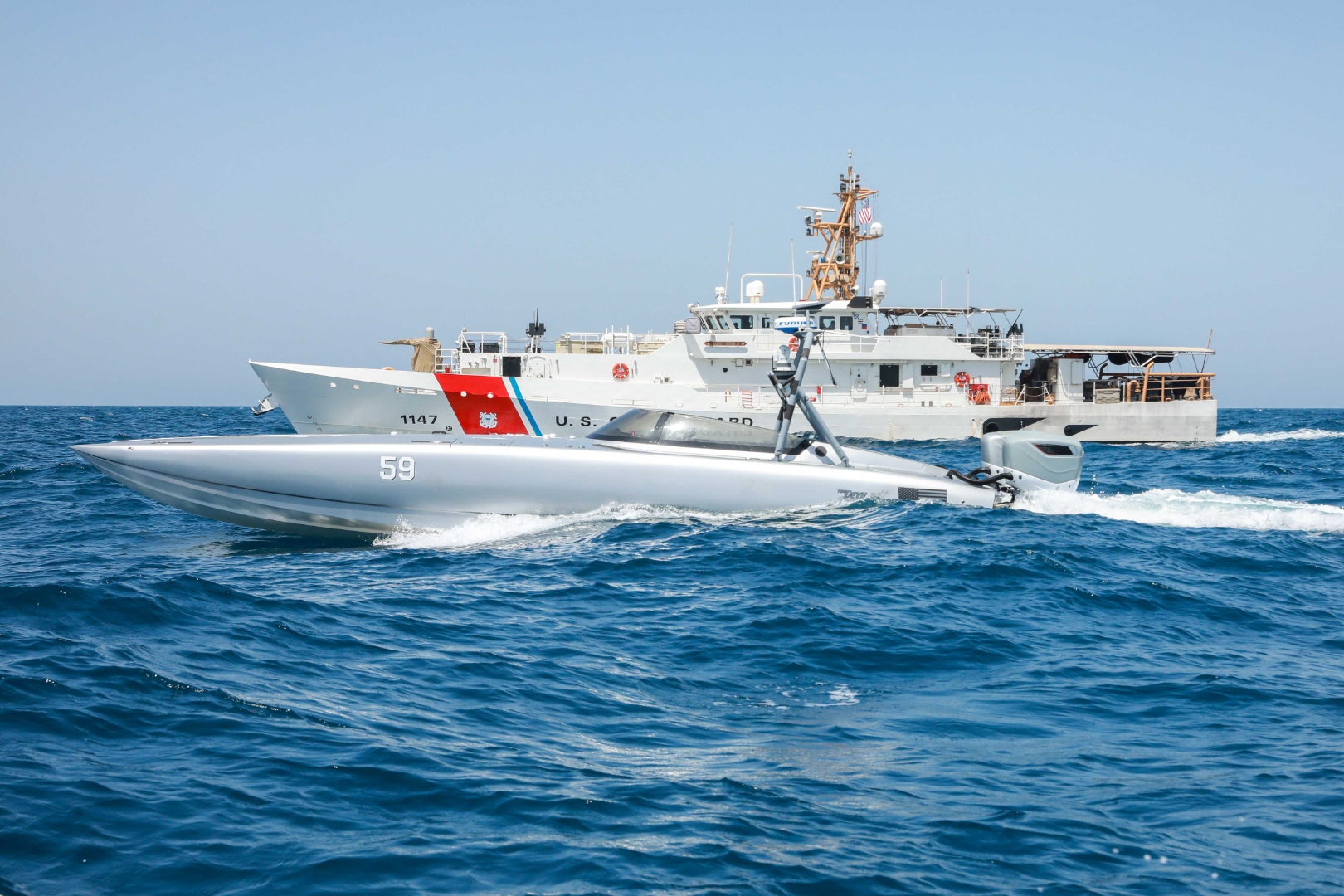
The U.S. Navy says it will add larger sea drones called medium unmanned surface vessels (MUSV) as a central element to President Trump’s vision of a “Golden Fleet.” MUSVs draw on the experience of experimental sea drones the U.S. Navy has been testing for years. As currently envisioned, MUSVs are characterized by container-style packages that can vary from aerial drone-launching bays to Tomahawk missile launchers. The U.S. Navy requires MUSVs to be capable of five days of autonomous operation without a communications link while maintaining a speed of 25 knots over a 2,500 nautical mile range. AI tech also is a critical element, being used to identify threats and generate appropriate responses. The Trump administration has allocated $2.1 billion for the development of MUSVs. Ultimately, the U.S. Navy sees sea drones as becoming its primary shooters with hundreds taking on the warfighting role normally associated with much fewer manned destroyers.
In the short term, the U.S. Navy plans to transfer a large experimental sea drone to active carrier group service this year. Reports identify this sea drone as the Sea Hawk, a medium displacement uncrewed surface vessel (MDUSV) originating from a DARPA research program and developed as a specialist diesel submarine hunter. The U.S. Navy expects 11 MDUSVs to be operational in 2027, a number that will subsequently swell to 30 by 2030.
Of course, the U.S. Navy also is interested in drone operations below the sea surface. Houston-based Cellula Robotics is emerging as an autonomous underwater vehicle (AUV) to the U.S. Navy. The company’s Guardian AUV is being designed for long endurance missions—it is required to stay submerged for 45 days at ranges of up to 3100 miles. The Guardian AUV is powered by fuel cells and is designed to carry substantial modular payloads for different missions in GPS-denied territorial waters.
If there is one difference between Ukrainian and American approaches to sea drones it’s that Ukraine views them as inexpensive, expendable weapons that are able to cripple a traditional navy to the point of embarrassing ineffectiveness. By contrast, the U.S. Navy sees sea drones as reusable “deep blue” assets, an approach that makes them inherently less expendable and more expensive. So far, battle experience favors the Ukrainian model but the different approaches reflect strategic operational requirements. Nonetheless, Ukraine has changed naval warfare by demonstrating you don’t need a navy to fight an enemy navy. In any event, there is no doubt that sea drones are a major change in marine calculus. Every navy in the world is looking at sea drone capabilities for a multitude of missions and concepts are quickly becoming reality. Ghost ships are no longer just scary sea legends.
Techstrong TV
Digital CxO Podcast
Digital CxO Webinars