
The Future of Product Management: Why Product Operations Is the Missing Link in Enterprise Success
This is an exciting time to be part of the product operations evolution. The conversation is shifting from how enterprises innovate to how they operate, and product operations is leading that shift.
For years, the focus has been on innovation, agility, and scale, but a quieter transformation has been unfolding behind the scenes, one that is reshaping how products are conceived, built, and delivered. At the center of this change is product operations, a function many companies are only beginning to fully recognize.
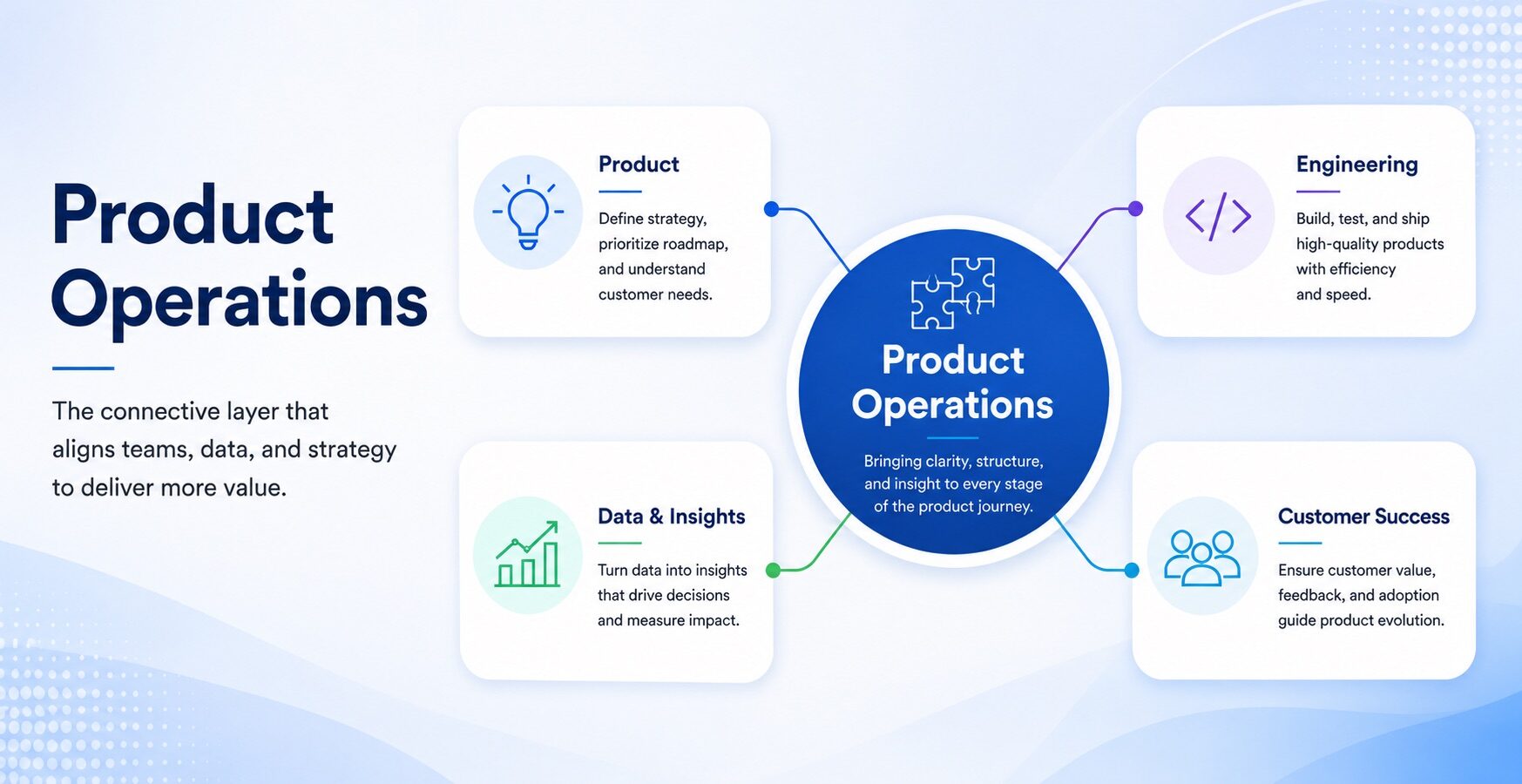
Product operations is emerging as the connective layer between product management, engineering, data, and customer success, bringing structure and clarity to how work moves across teams. Its purpose is straightforward, to make the product development process more efficient, more data-driven, and more closely aligned with business goals. Organizations have spent years refining how they build software, but far less attention has been given to how the overall system operates. Product operations is changing that.

Bridging Strategy and Execution
At its core, product operations makes sure that product teams have the right infrastructure, processes, and insights to make better decisions. It brings together the analytical discipline of operations with the strategic thinking of product management, creating a clearer path from idea to market. In traditional development environments, there are often gaps between product managers defining requirements, project managers tracking timelines, and engineers building the technology. As companies scale, those gaps can widen, leading to duplicated work, missed deadlines, and inconsistent results. Product operations help close those gaps, creating systems that promote visibility, accountability, and speed.
In many large enterprises, product data is spread across different tools—Jira for sprints, Salesforce for customer feedback, Tableau for analytics, and internal systems for operations. Product operations professionals consolidate this information into unified dashboards, giving leaders a single source of truth. That visibility allows teams to anticipate problems before they happen and align priorities based on measurable impact.
When I led an enterprise-wide software rollout in a healthcare system, consolidating fragmented data from multiple legacy systems and reporting tools helped increase reporting efficiency by over 65% which enhanced decision-making in the organization. This meant that cross-functional teams, such as finance, procurement, and IT, could work from a single source of truth, increasing trust and transparency and reducing manual back-and-forth.
The Merging of Product and Operations Skills
One of the biggest trends shaping enterprise software is the blending of traditional roles. Product managers, business analysts, and project managers once worked in clearly defined lanes, but today the most effective professionals draw from all three disciplines, combining strategic vision with operational precision.
I have seen over the years how the traditional disciplines in product and agile teams have evolved in large organizations vs. in startups. Enterprise companies tend to have specific roles and job duties for different departments, whereas in a startup, the same individual is often expected to wear multiple hats. More commonly these days, we see project manager and scrum master roles merging into one, while business analyst, product owner, and product manager roles are converging into a single role. This trend is expected to continue, especially with AI coming into the picture, so individuals should embrace upskilling to continue enabling operational delivery, strategy, and roadmaps alongside AI to stay ahead of the game.
Why Enterprises Are Paying Attention
The rise of product operations is also a response to a changing marketplace. Enterprise customers expect faster updates, responsive support, and consistent performance. That pressure puts product teams in a constant balancing act between speed and stability. Product operations provides the structure to maintain both.
A well-structured product operations function also serves as the organization’s operational conscience. It ensures that teams don’t just move fast but move intentionally. By creating feedback loops between customers, sales, and engineering, product operations shortens the distance between insight and action.
In one of the EHR scheduling integrations I led previously, the operations team had been receiving constant pushback from the clinicians’ office due to missing approval documentation required to see patients. Upon further investigation, I noticed that the system the scheduling team used vs. the one the nurse practitioners used had significant differences in UX layout. By analyzing workflow gaps, integrating necessary UX fixes to improve real-time scheduling visibility, and automating the process, we resolved the issue, increased physician satisfaction scores, reduced redundant paperwork, and enhanced physician block utilization and rounding times, allowing them to spend more time providing patient care. This showed how data-driven prioritization and automation of operational workflow can translate feedback into measurable improvement.
The Next Wave, AI and Accountability
As AI and automation continue to shape enterprise technology, product operations will only become more important. AI can generate insights, optimize workflows, and predict outcomes, but those capabilities mean little without the right operational framework. Product operations ensures that those insights reach decision-makers quickly and are acted on effectively.
It also brings accountability in an era of remote teams and global collaboration. With development spread across continents and time zones, coordination is more complex than ever. Product operations offers a governance model that balances flexibility with control, allowing teams to innovate while staying aligned on goals and outcomes.
If product teams today are not leveraging AI, they are surely missing out on opportunities to build more sophisticated and competitive products. Traditional product lifecycle vs. AI product lifecycle has significant differences, and even if teams are not building AI products specifically, they can still use AI tools in all three phases, discovery, delivery, and distribution, increasing efficiency in building 0 to 1 products. Today’s AI tools can help with market research, competitor analysis, and faster documentation. In healthcare settings, AI-powered workflows or copilots can help save clinician and admin time, and leaders can make more informed decisions from AI-predictive insights rather than relying on manual spreadsheets or manual status collection.
Many in the industry believe that roles like product manager, business analyst, and project manager will eventually merge into a single, more strategic role. This future leader will combine customer understanding, operational excellence, and data fluency. The next generation of product professionals won’t just manage individual products; they’ll manage the systems that make product creation possible.
Product operations will be at the center of that transformation. As organizations look to scale efficiently and deliver value more quickly, it will become a necessity. The companies that embrace this function early will be the ones best positioned to build not just better products, but better systems for creating them.
Product operations will continue to evolve as a capability that aligns governance, compliance, operations, data, and execution across regulated fields, enabling enterprises to achieve sustainable value and ROI for their products. As AI shapes the future of regulated tech, ProdOps will help balance compliance with AI-driven innovation.
Techstrong TV
Digital CxO Podcast