
Amazon Web Services (AWS) is previewing a framework that enables artificial intelligence (AI) agents to make micropayments in return for accessing resources such as web content, application programming interfaces (APIs), Model Context Protocol (MCP) servers, and other agents.
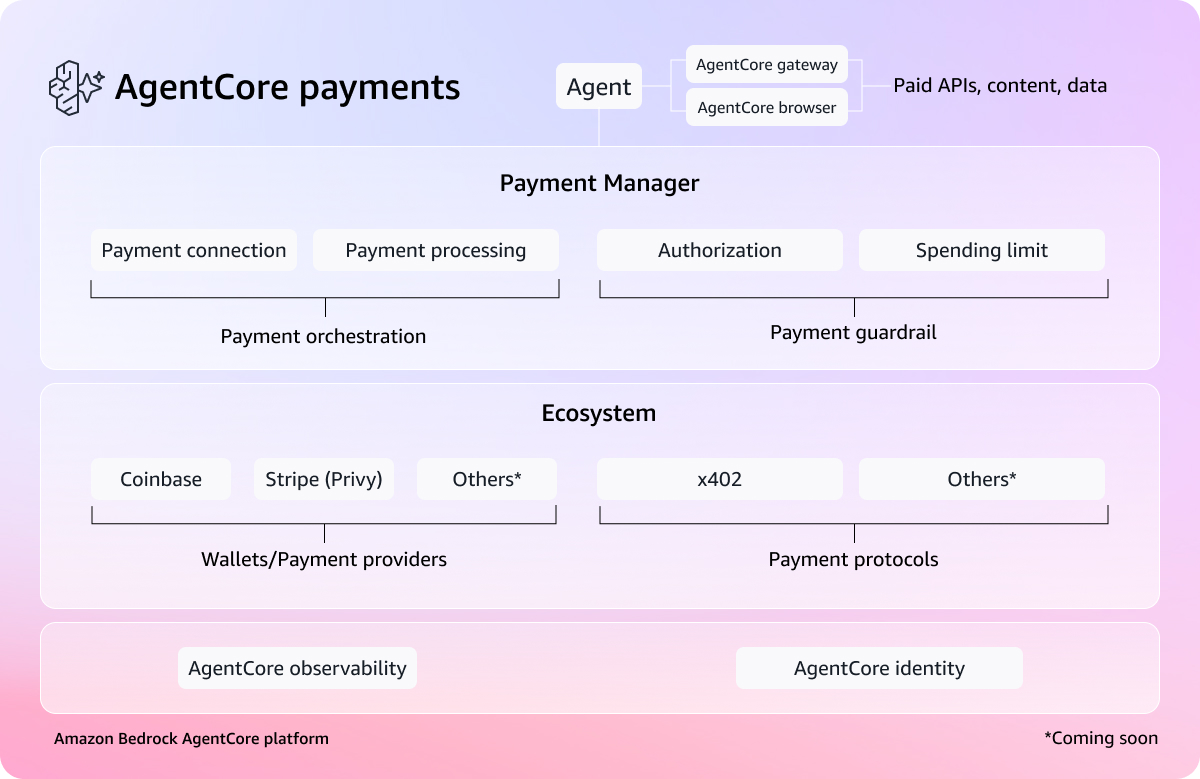
Developed in collaboration with Coinbase and Stripe, the payments extension to the Amazon Bedrock AgentCore service makes it possible to use the x402 protocol to provide AI agents with access to a digital wallet from which they are allowed to draw funds.
Support for additional protocols is planned and the x402 protocol itself is now being advanced under the auspices of an arm of the Linux Foundation. AWS is also making available the Coinbase x402 Bazaar MCP server via the AgentCore gateway to provide a curated list of x402 endpoints that agents can readily search, discover, and pay for as needed along with as of this week a set of guardrails for securing interactions.

This addition to the Amazon Bedrock AgentCore service is the first managed payment offering purpose-built for autonomous agents that spans everything from wallet authentication and transaction execution to spending governance and observability, says Preethi CN, director of Agentic AI for AWS.
The overall goal is to provide application developers with a higher level of abstraction via gateways to invoke various payment services in a way that doesn’t enable an AI agent to directly access a bank account, she adds.
Developers enable Amazon Bedrock AgentCore payments on their existing agent using the AgentCore SDK or console. Guardrails are enforced before an agent can transact and the end user must explicitly authorize the agent to access and use their wallet. At runtime, spending limits are enforced per session to keep agent spending within the confines of a set budget.
The extension to Amazon Bedrock AgentCore service streamlines those workflows that otherwise would be too challenging for application developers to build and maintain, she adds. “The cognitive load is too high,” she says.
AWS, in effect, is looking to drive a major expansion of the global digital economy by making it possible for AI agents to pay to consume resources that might cost less than a penny to access but ultimately drive billions of dollars of revenue.
In the future, payment services, tools, and content must be designed for both humans and agents, with AI agents being billed in real time, says CN.
This extension to the Amazon Bedrock AgentCore service signals a further shift to pay-per-use and consumption models, says Keith Kirkpatrick, vice president and research director for the Futurum Group. However, there are potential security risks involving millions of tiny transactions with dollar amounts that fall below alert thresholds unless there are specific safeguards put into place.
It’s not clear to what degree a standard might one day need to be created to ultimately achieve that goal, but the one thing that is certain is that there is a need for some mechanism to streamline micropayments. In the meantime, however, digital CxOs should assume that there is an opportunity to create major new streams of revenue via more granular services that, prior to the rise of agentic AI, would have been too small to be worth the trouble.
Techstrong TV
Digital CxO Podcast
Digital CxO Webinars