
The hottest combat aircraft right now may be the ones without a pilot. Collectively, these AI-enabled “loyal wingmen” are known as Collaborative Combat Aircraft (CCA). And while most CCAs adhere to a fixed-wing design, Anduril surprised many at the 2026 Farnborough Airshow in the UK with the debut of an autonomous rotorcraft designed to operate alongside helicopters.
Anduril’s hybrid-electric “Thunder” aircraft is a vertical takeoff and landing (VTOL) answer to the proliferation of drones that threaten to make crewed helicopters obsolete. “The proliferation of drones in land warfare has brought maneuver to a stalemate, extracting a significant toll in terms of man and machine,” says Anduril. “Attack helicopters and their crews, long the lifeblood of maneuver warfare, are increasingly held at risk by a combination of loitering munitions, cheap air defenses, and ubiquitous persistent ISR platforms that have rendered the near-surface domain one of the most lethal places on the battlefield.”
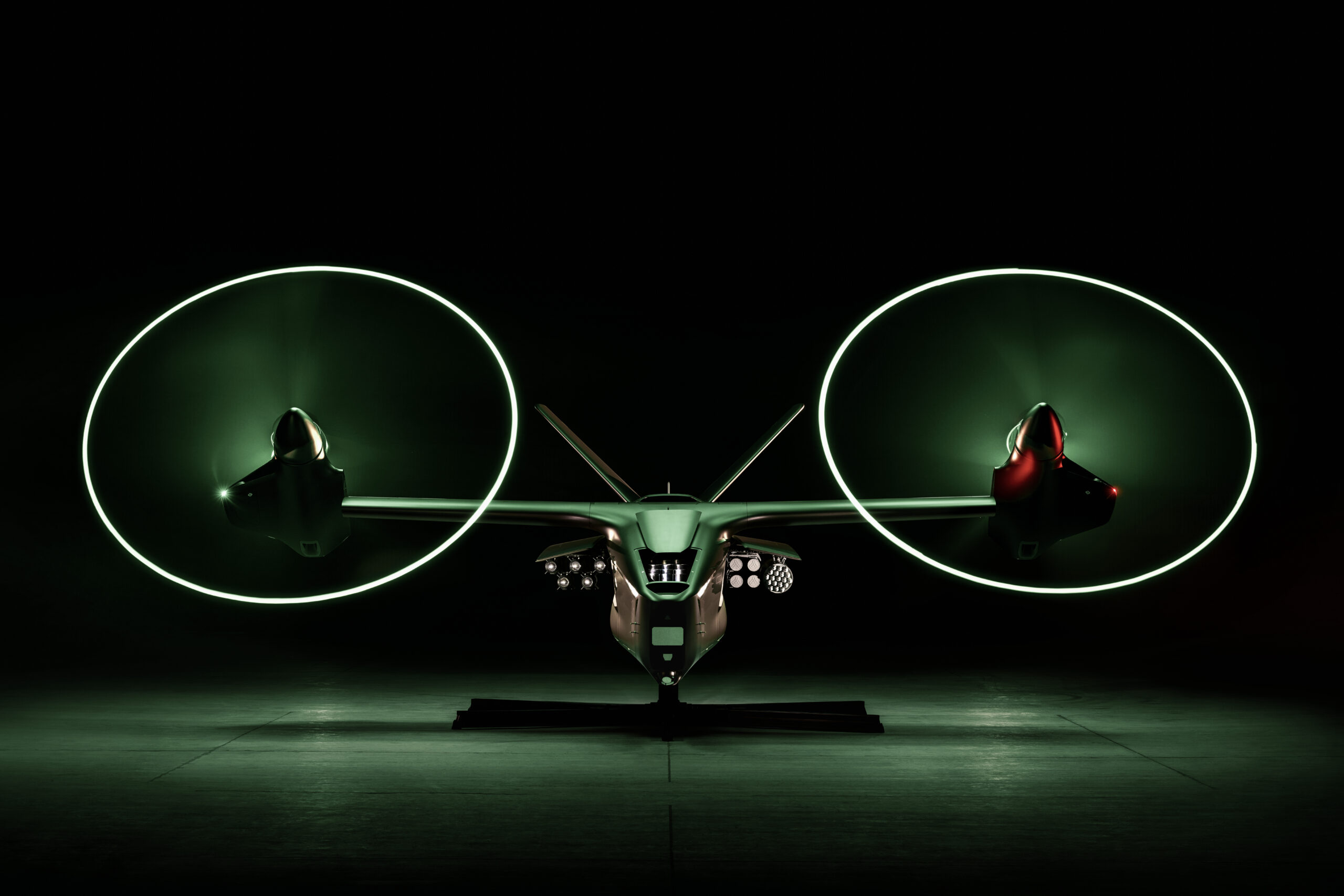
Photo Credit: Anduril

Envisioned Thunder missions include fire support, intelligence, surveillance, reconnaissance, maritime patrol, anti-submarine warfare, and search and rescue. One intriguing mission might include the delivery of armed unmanned ground vehicles to a combat zone, a tactic reportedly already being used in Ukraine via heavy-load-carrying drones. Thunder armament includes everything but the kitchen sink. A key feature is the use of Anduril’s core Lattice for Mission Autonomy software for formation flying so there is no need for pilot control.
Anduril is quickly becoming a major player in combat aviation. The U.S. Air Force this month completed its first live-fire test of Anduril’s fixed-wing YFQ-44A “Fury” CCA at Edwards Air Force Base. The Anduril CCA is meant to fly alongside crewed F-35 and F-47 fighters. Current doctrine envisions a pair of CCAs for each piloted aircraft with the decision to deploy weapons resting with the piloted aircraft.
Anduril’s CCA success is propelling the company into the upper ranks of defense contractors. Anduril is reportedly in funding discussions for a round that could value the company at roughly $100 billion, a valuation that would rival longtime defense giants Lockheed Martin and Northrop Grumman. The USAF CCA program is estimated to have a $2.37 billion budget line spread over several years. Anduril is the name of Aragorn’s reforged sword in Tolkien’s The Lord of the Rings fictional epic and translates from the Elvish as “flame of the west.”
Also on the CCA flight deck is the FQ-42A fixed-wing CCA from General Atomics which already has a production contract from the USAF and is scheduled for flight tests this fall. General Atomics says its CCA is optimized for missions that include electronic warfare and the acronym-heavy suppression of enemy air defenses (SEAD).
Farnborough 2026 was effectively a coming out party for CCAs. Boeing’s Australian wing debuted the MQ-28 “Ghost Bat” CCA that has already participated in a live fire exercise with a missile takedown of a drone. The Ghost Bat mirrors the general performance of most CCAs with a 2,000-mile range and a ceiling of 40,000 feet, specifications that put CCAs well beyond the capabilities of most drones. Ghost Bat was developed with the Royal Australian Air Force.
BAE, the UK’s biggest defense contractor, also entered the CCA fray with the Brontanax, a name derived from the ancient Greek words for thunder and king but evokes imagery of a flying dinosaur. BAE says its open architecture and modular design will make software upgrades easy. BAE also says it is developing a new helmet that will help pilots manage the additional data generated by loyal wingmen. The UK says it will invest $401 million to help launch a sovereign CCA program called Storm Fighter. Both BAE and Boeing Australia hope to capitalize on long-term defense doubts engendered by the Trump administration.
The funding available for CCA also is generating complex partnerships. For example, American aircraft maker BETA Technologies is partnering with GE Aerospace for propulsion and Sikorsky for autonomy to develop an unmanned MV208 VTOL by 2028 with a 1,300-mile range and a 2,000 pound payload that would rival Anduril’s Thunder VTOL model. Anduril, in fact, has Archer Aviation with its air taxi expertise as a partner for Thunder development.
The CCA flight deck is getting crowded.
Techstrong TV
Digital CxO Podcast
Digital CxO Webinars