
How to Slay AI Slop and Inspire Team Productivity
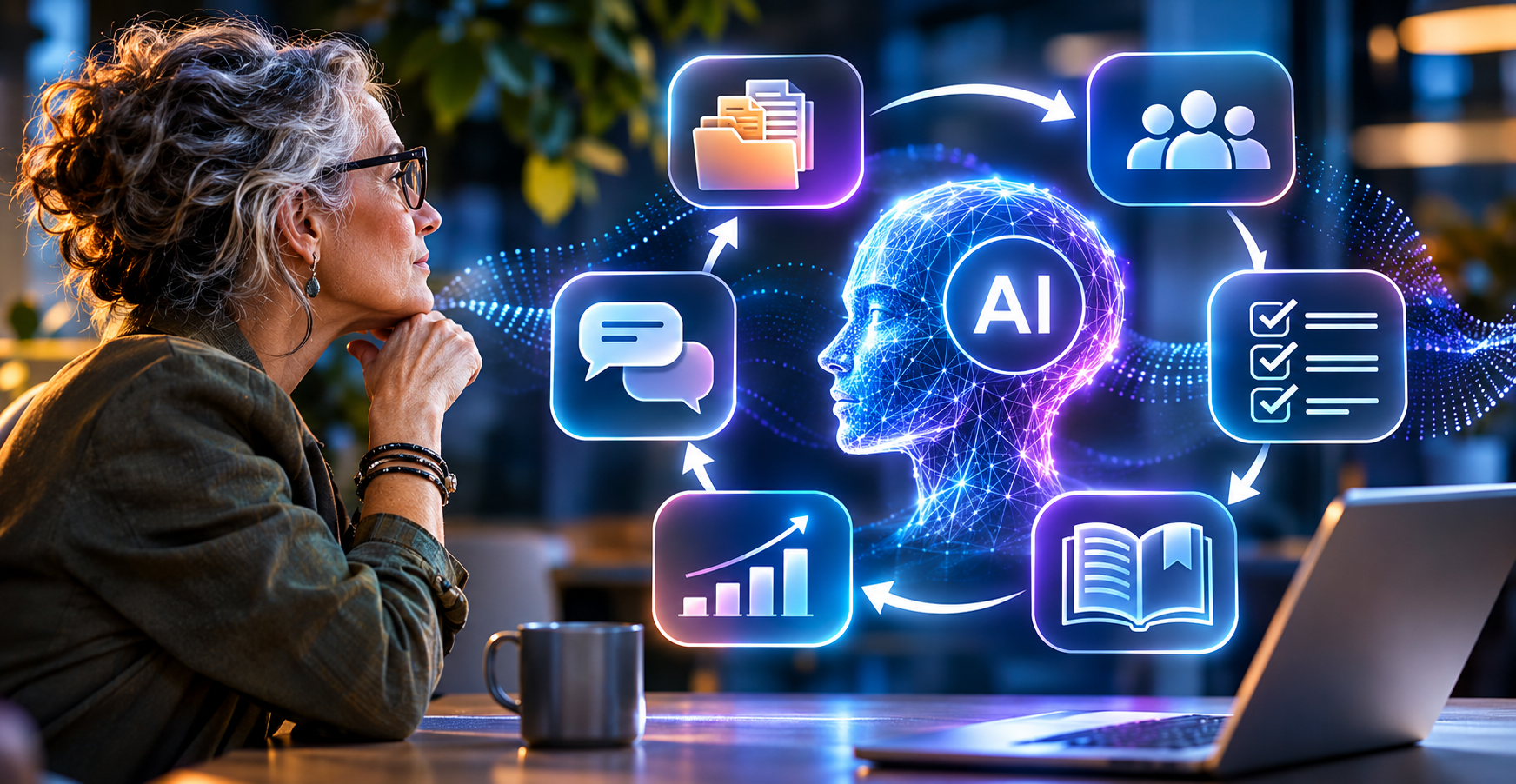
The backlash against AI slop is palpable. Editors now check copy for tell-tale signs of AI writing. LinkedIn responded to user frustration by introducing a “seems like AI” slop feature, which may help them reengage members and spark meaningful exchanges. More concerning are AI-generated outputs that lack insight and verified facts and are packaged in formulaic responses.
Depending on the source, reports on AI-related productivity point to overwhelm, low to no ROI, and diminished decision-making skills. Conversely, there are findings of AI driving significant time savings and more strategic value from teams.
Where is the disconnect? It’s in the human-AI connection.
This is not necessarily AI’s fault. It is what happens when AI is used as a standalone digital assistant or over-hyped search engine.
Setting Up Your Teams To Be Successful With AI
Getting value from AI requires building a knowledge system around your preferred LLM, such as Claude or ChatGPT. This system may include uploaded indexed files, audio recordings and meeting transcripts, style guides, organizational policies, and user-defined rules for how the LLM should respond to inquiries. The key is to write well-formed prompts that are put in step-by-step instructional order and that follow governance best practices. The goal is improved system predictability and higher user satisfaction.
To get better results from AI, think about the LLM as a replaceable intelligence engine. The system we use maintains provenance, durable memories, conversation history, and institutional knowledge. The institutional knowledge continuously evolves as humans interpret outputs from the LLM, render judgments, and refine that understanding.
The value is in building up organizational knowledge and keeping a record of what was learned and how decisions were made. The promise is faster and smarter decisions by humans and a way to recognize early when something may be going wrong.
Our knowledge system was designed to allow humans and AI to work together, following a process known as Collective Sensemaking. Achieving it doesn’t happen overnight. It requires refining the organization’s culture, processes, methods, operating principles, and task specifications. The next step is controlling how the information is handled.
We reduce hallucinations through clear instructions and context. We improve trustworthiness and minimize false AI responses by separating evidence from opinion, while preserving uncertainty. Further, we establish guardrails that inform responses using specific criteria based on the user’s goals, organization, and style. Our architecture has externalized memory that captures the evolving state of institutional understanding. Done right, you can get bespoke responses based on an individual’s regular exchanges with the AI.
It took about a year for our team to build a prototype. We now have a growing collection of written and spoken content generated by ourselves and our larger community of CIOs and business executives.
These are the steps we took to build the prototype of Collective Sensemaking.
Organization of information and iterative inquiry: Organize information into folders by projects or categories. Produce durable outputs, from inquiry-based conversations, in the form of insights, session feedback, executive takeaways, and most importantly memory records. These outputs are used by humans, who exercise their judgment to inform the next conversation. That conversation produces outputs and the cycle repeats.
Synthesis: In this phase, Collective Sensemaking identifies common patterns in conversations, documents sources, and notes tensions and provenance. Humans evolve institutional understanding by extracting knowledge and patterns from the synthesized information.
Reflection and revision: Every cycle of Collective Sensemaking leads to human reflection and revisions. It may not always lead to a conclusion, but it does create a record that is evidence-based, exposes potential tensions, allows for uncertainty, improves understanding, and informs follow-up inquiries.
Supporting long–term continuity: The system becomes a more reliable resource because it shows its sources and identifies uncertainties.
In the human-AI connection of Collective Sensemaking, don’t think of AI as the foundation. The foundation is made up of durable memories, organized information, rules, specific instructions, human validation, and continuing conversations across sessions. AI works within the system context to synthesize information at a speed not humanly possible. Once scaled to the enterprise, Collective Sensemaking may help businesses cope with AI slop, improve productivity, and get higher value from AI.
Techstrong TV
Digital CxO Podcast