
A dance crew of eight Unitree humanoid robots and one human take the stage tonight to compete in the finals of NBC’s America’s Got Talent (AGT) television show. And while the Unitree squad has a shot at the $1 million prize, it’s a small pittance compared to the staggering losses the Chinese robotics company has suffered in recent days as China applies the brakes to humanoid robots in general.
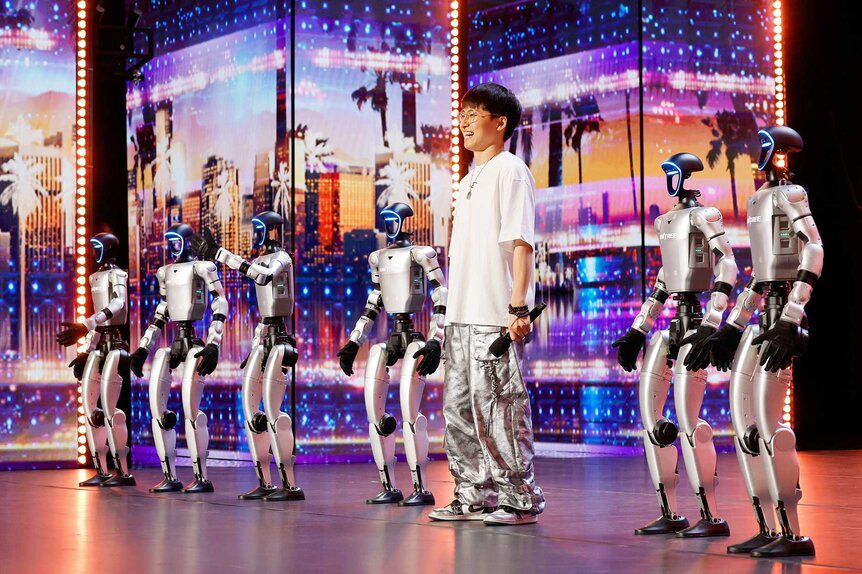
Image Credit: NBC
The human leading the Unitree humanoid dance crew is Wu Yufei, a 27-year-old dancer who describes dancing with the Unitree humanoids “a very magical feeling.” That magical feeling has largely disappeared back in China, however. The stock price of Unitree Robotics has slumped 55% from its initial market peak a month ago, according to Reuters. Chinese regulators are reportedly slowing the IPOs of humanoid makers across the board.

The concern appears to be worries about the long-term viability of revenue from humanoid robot sales. Currently, a large share of revenue for humanoid robots is derived from sales to government data centers where the humanoid robots are trained and from sales to local government joint ventures. In the first nine months of 2025, the vast majority of Unitree humanoid robot sales were to research and education customers with less than 10% coming from industrial customers, according to media reports.
What’s changed is that humanoid robots must now prove to be more than excellent dancers. The open question is whether humanoid robotics companies can generate independent demand. That means investors are now looking at real deployments, orders in volume, and proof that technical demos can be turned into commercial products. The heightened scrutiny means that at least a half dozen humanoid robotics companies have had their IPOs delayed, according to reports. The investment climate has shifted from blanket euphoria to selective rationality, noted one analyst.
Nonetheless, the Chinese government still considers “embodied intelligence”—its term for AI systems that perceive and act in the physical world—to be a strategic emerging industry. But for now, the Chinese government wants to dial back the hype.
Dancing robots, meanwhile, have captured the public’s imagination from an entertainment perspective. A 30-second dance routine, complete with synchronized somersaults, can take days to create and requires a team of engineers to be on hand to fine-tune movements during live performances. Power moves involving rotation are the easiest to program while moves requiring flexibility are the hardest.
Unitree’s AGT performance may be the day the music died for Chinese humanoids. China’s clampdown on dancing humanoids means that the robots may be soon looking for factory jobs. In America, at least, humanoid dancing will continue for one more night.
Techstrong TV
Digital CxO Podcast
Digital CxO Webinars